
Crop Monitor for Early Warning
Report Information
No. 113: Published March 5th, 2026
Conditions as of February 28th
For access to all reports, please visit the Archive.
Please visit the Referencing Guidelines page for information on how to cite the Crop Monitor reports and products.
Overview
In East Africa, dry conditions are negatively impacting Belg planting in Ethiopia, while an early start to the rainy season is generally benefitting first season planting along the south.
In West Africa, agro-climatic conditions remain favourable for ongoing rice production in Mali and Mauritania. Land preparation is underway for the 2026 main season cereals, and planting will begin in March.
In the Middle East & North Africa, conditions are mixed for wheat development as delayed rains at the start of the season were followed by a shift to recent precipitation improvements across many areas.
In Southern Africa, conditions are mixed for main season cereals, with dry concerns expanding across many areas and successive cyclone impacts in northern Madagascar.
In Central & South Asia, winter wheat continues to develop under favourable conditions. In Kazakhstan, a premature end to dormancy increases the risk of frost damage.
In Southeast Asia, conditions are favourable for wet-season crops in the south and dry-season crops in the north, except in conflict-affected areas of northwestern Cambodia.
In Central America & the Caribbean, conditions are favourable for second season rice in northern Honduras and Apante season beans in Nicaragua. Planting for the Primera season will commence in April.
Crop Conditions at a Glance
Crop condition map synthesizing information for all Crop Monitor for Early Warning crops as of February 28th. Crop conditions over the main growing areas are based on a combination of inputs including remotely sensed data, ground observations, field reports, national, and regional experts. Regions that are in other than favourable conditions are labeled on the map with a symbol representing the crop(s) affected.
EAST AFRICA:Belg season planting is just beginning in Ethiopia with early season dry concerns. An early start to the rainy season is mostly benefitting first season cereal planting in the south, except in the United Republic of Tanzania. Seasonal forecasts indicate average to above-average rainfall for the March to May 2026 long rains season across most areas (See Regional Outlook Pg. 6)
WEST AFRICA: Harvesting of both main and second season cereals mostly finalized in January under favourable conditions, except in conflict-affected regions and in Cape Verde. Land preparation is underway for the 2026 main season cereals, and planting will begin in March.
MIDDLE EAST & NORTH AFRICA: Delayed rains at the beginning of the season negatively impacted wheat planting and crop emergence in parts of Algeria, Libya, Syria, and Iran. Elsewhere, recent rainfall improvements are expected to result in favourable outcomes.
SOUTHERN AFRICA: Conditions are mixed for main season cereals. Dry concerns have expanded across Angola, eastern Democratic Republic of the Congo, Zimbabwe, Mozambique, eSwatini, and southern Madagascar following a dry spell in February, while northern Madagascar was negatively impacted by the passage of Tropical Cyclones Fytia and Gezani.
CENTRAL & SOUTH ASIA: Winter wheat continues to develop under mostly favourable conditions. However, forecast dry and hot conditions this spring elevate risks to rainfed crop production (See Regional Outlook Pg. 13).
SOUTHEAST ASIA: Conditions are generally favourable for wet-season rice and maize in the south and dry-season rice and maize in the north due to conducive weather outcomes, adequate irrigation water availability, and sufficient sunlight. However, conflict in northwestern Cambodia is expected to reduce the national planted area of dry-season rice.
CENTRAL AMERICA & CARIBBEAN: Segunda/Postrera season crops are now out of season, and planting for the Primera season will commence in April. In Cuba, drier than normal conditions and foreign reserve shortages are negatively impacting yield prospects for second season maize and rice crops.
Global Climate Outlook: Two-week forecast of areas of above or below-average precipitation
The two-week forecast (Figure 1) shows a chance of above-average precipitation over eastern Canada, the Mid-West and southern Great Plains in the US, eastern Cuba, Haiti, the Dominican Republic, Colombia, Venezuela, western Ecuador, Guyana, northern Suriname, northern French Guiana, northwestern Brazil, southwestern Peru, northern Chile, southwestern Bolivia, northwestern Argentina, eastern Spain, southeastern Kenya, central Tanzania, northern Mozambique, central Zambia, southern Malawi, southern Angola, northern Namibia, central Botswana, northern Madagascar, southern and southeastern Kazakhstan, Bhutan, northeastern India, Bangladesh, northern Myanmar, southwestern China, northern Laos, the Philippines, and northern and central Australia.
There is also a risk of below-average precipitation over the western and southeast United States, central and eastern Brazil, southern Chile, Ireland, the UK, Norway, Sweden, Finland, Estonia, Latvia, Lithuania, Belarus, France, Belgium, the Netherlands, Germany, Denmark, Poland, Czechia, northern Switzerland, northern Austria, Slovakia, northern Hungary, Ukraine, southern Greece, southwestern Türkiye, the western Russian Federation, southern Tunisia, northwestern Libya, eastern Saudi Arabia, eastern Oman, eastern Liberia, eastern Côte d'Ivoire, Ghana, Togo, Benin, central and southern Nigeria, Cameroon, southern Chad, the Central African Republic, Equatorial Guinea, Gabon, southern Republic of the Congo, northwestern Angola, northern Democratic Republic of the Congo, South Sudan, northwestern Uganda, Ethiopia, southern and northern Somalia, eastern Iran, eastern Turkmenistan, Afghanistan, Pakistan, northwestern to southern India, Sri Lanka, western Nepal, western and southeastern China, northeastern Mongolia, southern Japan, northern Cambodia, Thailand, Malaysia, Indonesia, and central Papua New Guinea.
Figure 1: IRI SubX Precipitation Biweekly Probability Forecast for 7 – 20 March, issued on 27 February 2026. The forecast is based on statistically calibrated tercile category forecasts from three SubX models. Source: IRI Subseasonal Forecasts Maproom
Climate Influences: ENSO neutral conditions are forecast during March to August with an increasing chance of El Niño event following
La Niña conditions were present but in decline during February 2026. ENSO conditions will most likely be neutral during March to May 2026 (90 percent chance) and June to August 2026 (56 percent chance), according to the NOAA CPC ENSO Outlook. There are increasing chances that an El Niño event will develop this year, potentially between August and October 2026 (59 percent chance). While long-range forecasts made at this time of year can be unreliable, El Niño events can have widespread, global impacts.
Global temperatures for January 2026 were the fifth warmest on record, according to the Copernicus Climate Change Service Climate Bulletin. If El Niño conditions develop during 2026, these will likely have a warming effect on global temperatures.
During late February through mid-March, above-average temperatures are forecast in northwestern, central-western, and southeastern Africa, southern South America, southern and western Asia, southern and eastern Canada, Europe, Japan, northern Mexico, Madagascar, western Russia, and the United States. Warmer-than-average temperatures can negatively impact snowpack development, and have already been an issue in central-southern Asia in recent weeks and the United States in recent months.
Below-average temperatures are forecast in parts of central-northern and eastern Africa, southeast Asia, central Australia, and the Middle East. In Alaska, northern Canada, and parts of northern Russia, very cold, below-average temperatures are forecast.
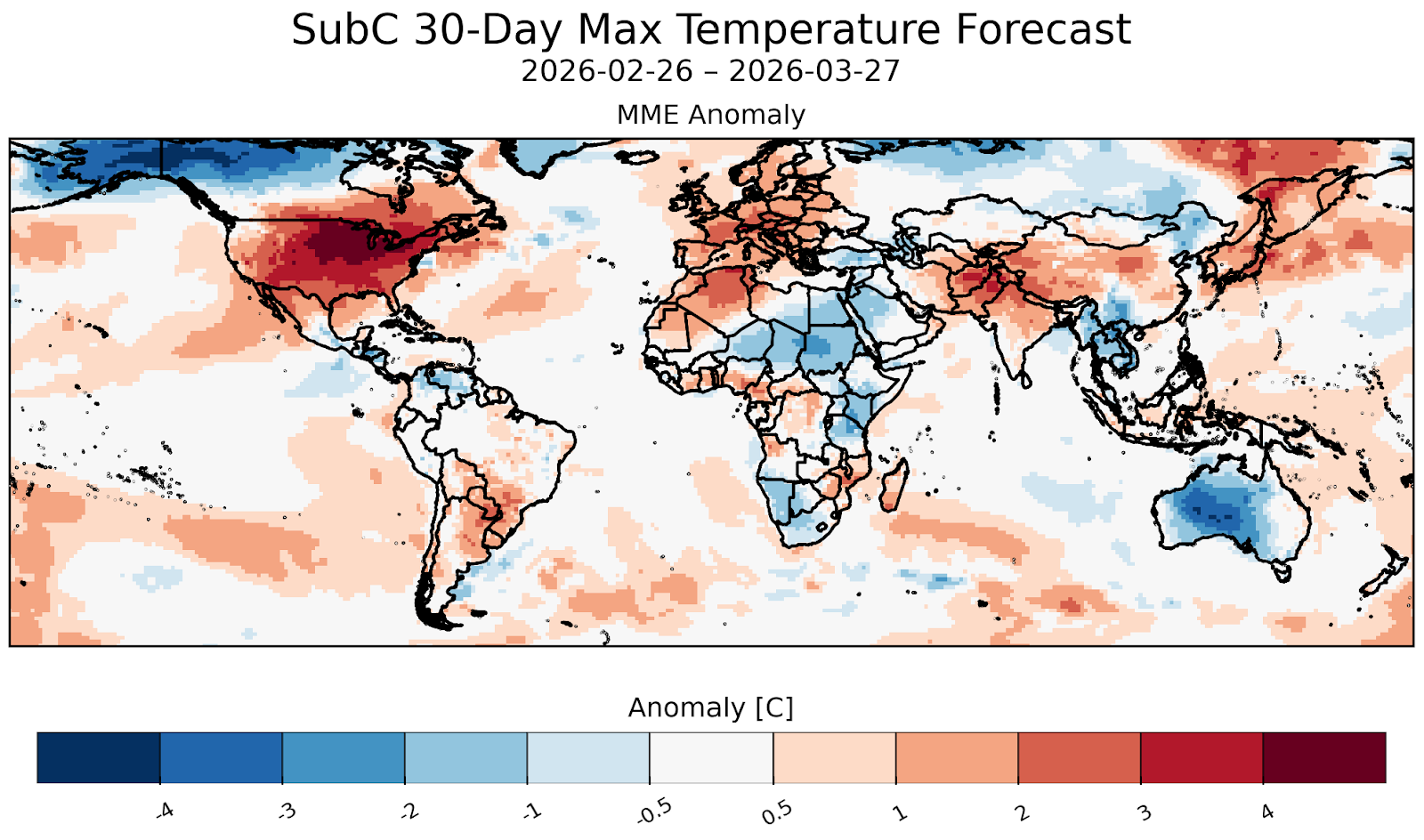
Figure 1. Maximum temperature anomaly forecast for the next 30 days starting on 26 February 2026, from three Subseasonal Consortium (SubC) models. SubC data accessed from the IRI Data Library. Map source: UCSB Climate Hazards Center.
East Africa
Crop condition map synthesizing Maize 1 crop conditions as of February 28th. Crop conditions over the main growing areas are based on a combination of inputs including remotely sensed data, ground observations, field reports, national, and regional experts. Conditions that are other than favourable are labeled on the map with their driver.
Across northern East Africa, winter wheat continues to develop in Sudan with ongoing concern due to various conflict-related disruptions. In Ethiopia, planting of Belg season maize is just beginning with early season dry concerns in most areas, except in the southeast which experienced an early start to the season.
Across southern East Africa, harvesting of second season cereals finalized in Rwanda, Burundi, Kenya, and the United Republic of Tanzania under mixed conditions. Failure outcomes are expected in bimodal and minor producing regions in the eastern half of Kenya due to dry and hot seasonal weather outcomes, while poor outcomes are expected in eastern Burundi and central Kenya due to persistent dryness. Conversely, favourable yields are expected in Rwanda, western Burundi, and unimodal and major producing regions in the western half of Kenya. Final conditions for second season cereals are mixed in the United Republic of Tanzania, and end of season outcomes will be reported next month. Additionally, planting and development of first season cereals is underway in bimodal areas of Uganda, Rwanda, Burundi, and the United Republic of Tanzania. Delayed rains are causing concern for crops in the vegetative to reproductive stage in the United Republic of Tanzania, while start of season conditions are favourable elsewhere.
The October to December 2025 short rains season was characterized by below-average precipitation across most regions, with extreme rainfall deficits across Somalia, east and southeastern Ethiopia, and the eastern half of Kenya, which all experienced poor to failure cropping outcomes. Dry conditions persisted through February 2026 across many areas, exacerbating severe dry conditions, and above-average temperatures limited crop recovery. Pasture and water resources have continued to deteriorate across affected areas, prompting challenges for livestock migration. Seasonal forecasts indicate average to above-average rainfall for the March to May 2026 long rains season across most regions, which is expected to bring relief to crop and rangeland areas. (See Regional Outlook Pg. 6).
Crop condition map synthesizing Sorghum 1 conditions as of January 28th. Crop conditions over the main growing areas are based on a combination of inputs including remotely sensed data, ground observations, field reports, national, and regional experts. Conditions that are other than favourable are labeled on the map with their driver.
Northern East Africa & Yemen
In Sudan, harvesting of main season sorghum and millet finalized in January, and production is expected to be below average due to a combination of continued conflict, erratic rainfall, and flooding outcomes this season. Insecurity disrupted planting and harvesting activities in Darfur, Kordofan, and Blue Nile, and farmers abandoned their fields in the most affected areas. Additionally, fuel shortages and high input costs resulted in a decreased cultivated area. Wheat crops are in the vegetative to reproductive stage, and harvesting is expected to begin in March. However, a combination of high imported seed and fertilizer costs, fuel shortages, damaged infrastructure, and reduced irrigation capacity is expected to result in below-average wheat production in key producing areas, increasing the country's reliance on imports amid strong currency depreciation. In Ethiopia, planting of Belg season maize is just beginning under mixed conditions, with dry concerns in parts of the north and centre where precipitation over the last month was below average. Conversely, conditions are favourable in the southwest, which experienced an early start to the season. The season is expected to peak during March and April, when above-average rains are expected across Belg growing areas (See Regional Outlook Pg. 6).
Crop condition map synthesizing Maize 2 conditions as of February 28th. Crop conditions over the main growing areas are based on a combination of inputs including remotely sensed data, ground observations, field reports, national, and regional experts. Conditions that are other than favourable are labeled on the map with their driver.
Southern East Africa
In Somalia, harvesting of Deyr season maize and sorghum crops finalized in January, with failure yield outcomes in the south and poor outcomes in the centre and northwest due to the failed October to December 2025 Deyr rains. During past years with similar La Niña patterns, Deyr season maize yields were over 40 percent below normal in the Bay region, and sorghum yields were 20 to 30 percent below normal across the country, particularly in Bay and Bakool regions located in the south. A typical dry and hot January to March Jilaal dry season is underway. Pasture and water resources are extremely limited following the failed October to December 2025 Deyr rains. Additionally, above-average temperatures are rapidly deteriorating water reserves, increasing pressure for pastoral and agro-pastoral livelihoods until the start of the Gu rains. The April to June Gu season rains are expected to begin on time, though forecast cumulative amounts remain uncertain. In Kenya, rice harvesting is now complete while harvesting of short rains maize is nearing completion. Failure outcomes are expected in bimodal and minor producing regions in the eastern half of the country, and poor outcomes are expected in the centre due to an exceptionally dry October to December 2025 short rains season in combination with above-average temperatures. Conversely, favourable outcomes are expected in the unimodal and major producing western half of the country. Land preparation for the long rains season is just beginning, and planting will commence in March. In bimodal areas of Uganda, planting of first season maize and millet is just beginning under favourable conditions, with an earlier than normal start to the season. In Burundi, harvesting of Season A crops (35 percent of annual crop production) finalized in February, with poor yield outcomes expected in the east due to the poor performance of the September to November 2025 short rainy season. A late start to the rains in mid-September disrupted planting operations and negatively impacted crop germination. Adequate rains in October were followed by a return to below-average amounts in November that negatively impacted crop maturation. As a result, overall production is expected to be below average, particularly in eastern areas, including in Eastern Lowlands, Northern Lowlands, and in Imbo Plains, where 50 and 80 percent of maize and bean crops have been lost, respectively. Conversely, yield outcomes are expected to be favourable in the west. In Rwanda, harvesting of season A crops (60 percent of annual crop production) finalized in February, and final conditions are favourable despite rainfall delays at the beginning of the season. In Rwanda and Burundi, planting of Season B maize is just beginning, and an earlier than normal start to the season has contributed to favourable conditions. Recent above-average rainfall amounts are expected to continue through mid-March (See Regional Outlook Pg. 6). In the United Republic of Tanzania, harvesting of Vuli season maize and sorghum finalized in February, and yields are expected to be mixed due to dry impacts in some areas. Final end of season conditions will be reported next month due to yield uncertainty. Additionally, planting and development of Masika (bimodal regions) and Msiumu (unimodal regions) crops continue with ongoing concern due to early-season rainfall deficits. While some rain has been received in late February, it is not yet sufficient to restore biomass levels for crops in the vegetative stages. However, it will likely benefit those that are currently being planted or are in the establishment phase. Additionally, forecast wetter than normal rainfall outcomes through mid-March will likely improve overall crop conditions (See Regional Outlook Pg. 6).
For detailed description of the pie chart please see description box on the bottom of the page.
Regional Outlook: Above-average rains forecast in western and southern East Africa through mid-March 2026
Late-January through mid-February rainfall totals were above average in Uganda, Rwanda, Burundi, western Kenya, and across most of western Tanzania (Figure 1-left). Drier-than-average conditions occurred in other areas, leading to small rainfall deficits in central and southwestern Ethiopia at the start of the Belg season, and below-average rainfall continued in central and southern Kenya and eastern Tanzania. Moderate rainfall during February 21st to 23rd improved rainfall conditions in Kenya and eastern Tanzania, based on RFE2 data.
During the last week of February and the first part of March, conditions will be much wetter than average. Widespread above-average rainfall is forecast by the GEFS and ECMWF systems during February 26th to March 12th, across southwestern-central Ethiopia, Kenya, eastern Uganda, Rwanda, Burundi, and Tanzania. Moderate to high rainfall amounts are anticipated, such as 15-day forecast rainfall totals that may be 100+ mm higher than average in parts of northern, central, western and southern Kenya and northern, central, and southern Tanzania, according to the CHIRPS-GEFS forecast from February 26th (Figure 1-middle). The forecast rains are sufficient to initiate an early start of the season in central, southwestern, and southeastern Kenya, where the season is expected to start in late February to early March.
If the forecast rains materialize, it will bring a much needed reprieve from the drought conditions in central-eastern Kenya. However, heavy rainfall may also increase risks of flooding in lowlying and riverine areas. In late February, hundreds of families were displaced in western Kenya, when River Migori burst its banks following heavy downpour.
In drought-affected areas of Somalia and southeastern Ethiopia, most areas will likely remain seasonally dry or with low but near-average rainfall amounts, based on the CHIRPS-GEFS 15-day forecast from February 26th (Figure 1-middle). However, forecasts diverge during the second week of that forecast period. The February 25th ECMWF forecast indicates above-average rainfall during March 2nd to 9th, and average to below-average rainfall in eastern areas in the weeks after.
There is considerable uncertainty about rainfall conditions during late March across the region, as sub-seasonal forecasts suggest mixed conditions and have low accuracy at long lead times. The March to May (MAM) 2026 seasonal outlook from ICPAC (Figure 1-right) is generally optimistic about MAM 2026 rainfall performance, with most areas forecast to most likely receive above-normal or normal rainfall. There are slightly elevated (40 to 50 percent) chances of above-normal rains in Ethiopia, central Somalia, most areas of Kenya and parts of Uganda. Tanzania shows higher forecast probabilities for above-normal rainfall. There are currently 6.5 million people facing acute food insecurity in Somalia due to the failed Deyr 2025 season rains, conflict, displacement, and high food prices. Given the uncertainty at longer lead times, close monitoring of short-range forecasts will be essential to track the evolution of March to May rainfall and impacts on agriculture, water resources, and flood risks.
Figure 1. Recent rainfall anomaly, a 15-day rainfall forecast anomaly, and a 3-month rainfall probability forecast. Left: A CHC Early Estimates, which compares the January 21st to February 20th, 2026 precipitation total to the 1981–2025 CHIRPS averages for the same accumulation period. This panel uses CHIRPS3 Preliminary for February 1-20, 2026. Middle: Forecast next 15-day precipitation anomaly for February 26th to March 12th, from the CHIRPS3-GEFS forecast, which is a bias-corrected (to CHIRPS v3) version of the NCEP GEFS ensemble mean. Right: Seasonal forecast for March to May (MAM) 2026 rainfall, from the IGAD Climate Prediction and Applications Centre (ICPAC) March forecast update. Source: (ICPAC).
West Africa
In West Africa, harvesting of both main and second season cereals mostly finalized in January 2026 in all regions under favourable conditions, with the exception of conflict-affected regions and in Cape Verde were below-average and erratic rains negatively affected cropping outcomes. Along the Sahel, harvesting of main season rice finalized in Mali, and harvesting of second season rice is now underway under favourable conditions, except in the centre where ongoing conflict continues to impact agricultural activities. Second season rice continues to develop in Mauritania under favourable conditions. Land preparation is underway for the 2026 main season cereals across the subregion, and planting will begin in March.
Middle East & North Africa
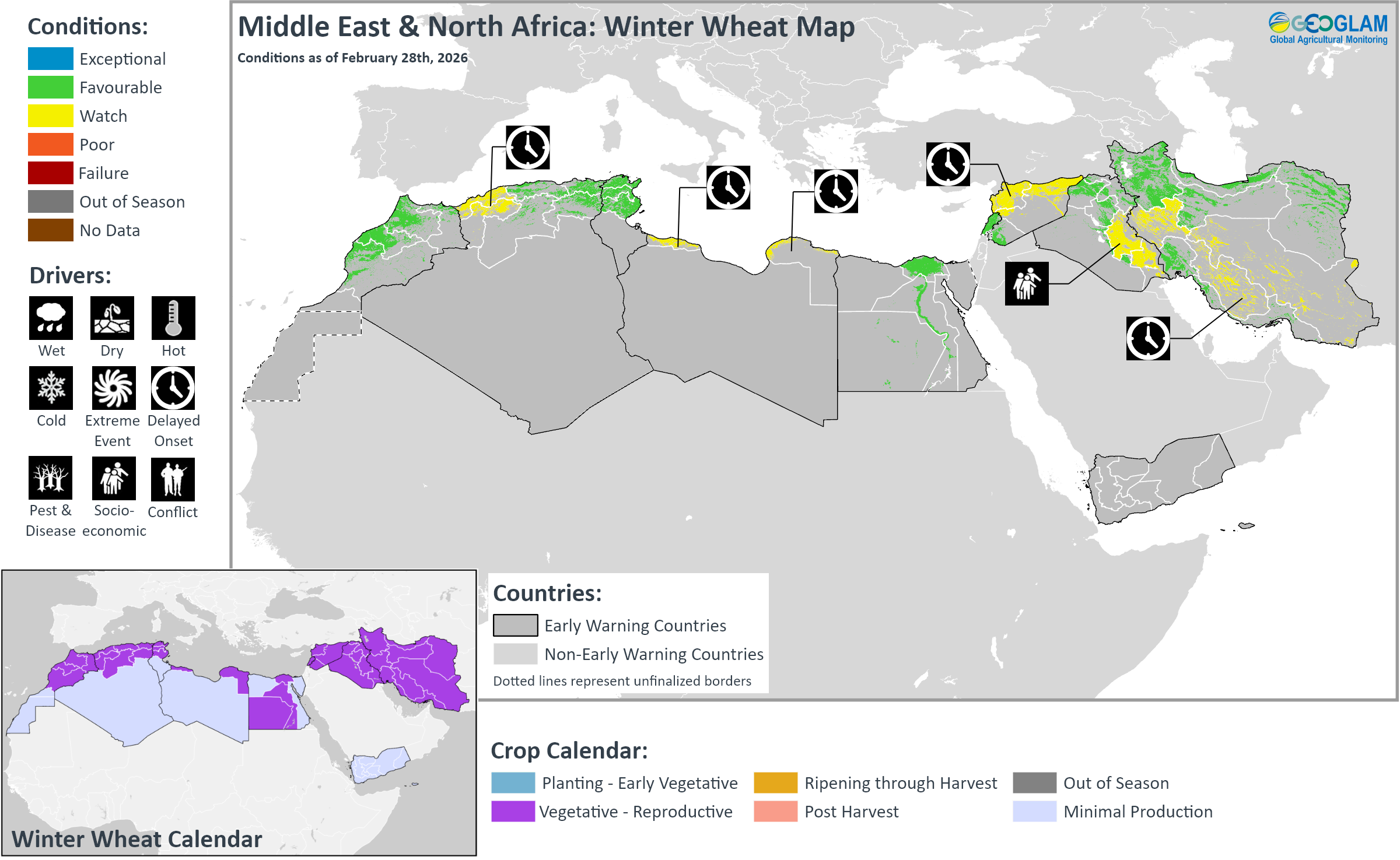
Crop condition map synthesizing Winter Wheat conditions as of February 28th. Crop conditions over the main growing areas are based on a combination of inputs including remotely sensed data, ground observations, field reports, national, and regional experts. Crops that are in other than favourable conditions are labeled on the map with their driver.
Across the Middle East and North Africa, winter wheat continues to develop across Morocco, Algeria, Tunisia, Libya, Egypt, Lebanon, Syria, Iraq, and Iran under mixed conditions. Delayed rains at the beginning of the season in October and November 2025 were followed by precipitation improvements in December 2025 and January 2026. The rains helped to ease drought conditions that have persisted across western North Africa for six years and contributed to reservoir replenishment, which are 70 percent filled on average in Morocco and over half filled in Algeria and Tunisia. However, the early season dry conditions negatively impacted planting activities and crop emergence in many areas and continue to cause concern in western Algeria, Libya, much of Syria, and parts of Iran. In parts of southeastern Iraq, crop biomass is below average due to a government decision to limit the area of cultivation using surface water. Elsewhere, recent rainfall improvements are expected to result in favourable outcomes. However, the rapidly escalating conflict in Iran and the broader Middle East poses a significant risk to agricultural production and supply chains if hostilities continue.
In Morocco, a delayed and drier than average start to the season from October to mid-November resulted in later than normal planting in December 2025. Conversely, rainfall improved from the end of November, particularly in mid-December, bringing rainfall totals to the highest in the last 25 years in central and northwestern areas, from Tadla Azizal and Chaouia to Tanger-Tétouan. The rains increased water levels for irrigation in key producing regions and improved soil moisture that supported crop establishment and early development. Growing conditions are favourable, and biomass is above average in the west, except in Gharb where flooding impacted agricultural land. Biomass is near average in the east, mainly in Tadla Azilal, Meknes, and Oriental provinces, where dry conditions at the start of the season delayed initial cereal growth. Overall conditions are favourable for winter cereals, and if rainfall continues to meet crop needs, there is a strong potential for yield rebound after several consecutive seasons of severe water scarcity. In Algeria, rainfall distribution has been mixed since the start of the season, resulting in mixed growing conditions. Western regions, from the Moroccan border to Ain Defla, experienced rainfall deficits in October and November 2025 that resulted in some delayed planting operations and constrained early crop establishment. While rainfall has improved since mid-December 2025, biomass remains below average in these areas as earlier dry conditions delayed the start of the season. Conversely, biomass for winter cereals is average to above average in the eastern half of the country, from Bouira to the Tunisian border, where near-average rainfall since the start of the season benefited planting and early development. In Tunisia, the season began with significant rainfall deficits in October and November 2025, which delayed the start of cereal growth. Rainfall amounts improved in December 2025 and January 2026, supporting winter cereal recovery and development. Vegetation conditions are favourable in the main producing north and central regions, with near-average biomass in Bizerte and above-average biomass in Beja, Jendouba, Le Kef, Siliana, and Kairouan. The favourable growth is supported by the use of certified seeds, which has more than doubled compared with the previous season. Conversely, crop growth has been strongly delayed in localized parts of the east, including in Nabeul, Zaghouan, and Ben Arous. In Libya, despite good rainfall in December in the western half of the country, particularly around Tripoli, there is concern from Az Zawia to Misurata due to early season dry conditions. Conditions are mixed in the east, with good biomass in Al Fatah and below-average biomass in Darna. In Egypt, growing conditions remain favourable as crops are predominantly irrigated.
In Lebanon, the delayed onset of the seasonal rains until mid-December 2025 resulted in delayed winter cereal planting. The planted area is expected to be below average as cereal crops are mostly rainfed. Rainfall improvements in January 2026 benefitted soil moisture levels and supported crop establishment, and vegetation conditions are above average as of the second dekad of February. However, expected highly above-normal temperatures through April may constrain yield prospects. In Syria, planting of winter cereals started late in rainfed areas due to delayed onset of the seasonal rains until December 2025. Despite above-average rains received in December 2025 and January 2026 and conducive temperatures since February, crop biomass is well below average in the main producing north, particularly in Aleppo, Idleb, and Homs, likely due to delayed sowings and a reduction in the planted area. In these areas, biomass is worse than in 2025, which experienced the driest to second driest season since 2001. Conversely, conditions are favourable in the south from Damascus to Dara and in Dayr Az Zor. Rainfall outcomes through April will be critical for adequate crop development. In Iraq, an early season rainfall deficit in October and November 2025 was followed by improved precipitation at the end of November and from December 2025 to early January 2026, particularly in the north, and rainfall totals are now above average in most areas. However, conditions remain mixed, with near-average biomass in the main producing northern areas, including in Ninewa, Dahuk, Erbil, Kirkuk, Salah Al-Din, and Diyala, and well below-average biomass in the southeast, including in Babil, Qadissiya, Wassit, Thi-Qar, and Missan, with the exception of Najaf. The biomass deficit is attributed to a government decision to limit the area of cultivation using surface water to about 250,000 hectares (1 million dunams) or 50 percent of the typical area. The plan also mandates the use of modern irrigation for all wheat crops to conserve water resources. An additional 875,000 hectares (3.5 million dunams) will be cultivated using groundwater. In Iran, below-average rainfall at the end of October and particularly in November 2025 was followed by a shift to abundant rains received from December. However, biomass for winter cereals remains mixed, with average to above-average biomass in the north, from West Azerbayejan and Kordestan to Golestan and Khorasan, and in the north-centre. Conversely, biomass is below average in parts of the centre-west, particularly in Kermanshah as well as in Lorestan, Esfahan, Ghom, and Fars, with the exception of the main wheat-producing Khuzestan province, which has above-average crop biomass.
Southern Africa
Crop condition map synthesizing Maize 1 conditions as of February 28th. Crop conditions over the main growing areas are based on a combination of inputs including remotely sensed data, ground observations, field reports, national, and regional experts. Crops that are in other than favourable conditions are labeled on the map with their driver.
Across Southern Africa, harvesting of main season cereals is just beginning in Angola and Zambia, while crops continue to develop in Namibia, Botswana, Zimbabwe, Malawi, Mozambique, Madagascar, South Africa, Lesotho, and eSwatini. Dry concerns have expanded this month and are now impacting crops across Angola, eastern Democratic Republic of the Congo, Zimbabwe, Mozambique, eSwatini, and southern Madagascar. While central eastern areas were affected by heavy rains in December 2025 through mid-January 2026, many of these areas have also been affected by an ongoing dry spell over the past month. Elsewhere, near-average cumulative rainfall is generally supporting favourable growing conditions despite mixed rainfall outcomes over the past month. In central areas, seasonal rainfall totals are near to above average but with uneven distribution. Conversely, the passage of Tropical Cyclones Fytia and Gezani in late January and mid-February may constrain cropping outcomes in northern Madagascar.
In Angola, west, central, and northern areas have experienced erratic rainfall since the start of the season. Totals are significantly below average, with little to no rainfall received in the past month and above-average temperatures in some areas. Conversely, conditions are favourable in the south and east. In Zambia, very heavy rainfall from late December 2025 to early January 2026 impacted northeastern areas, resulting in widespread flooding and displacement. Recent flooding has washed away more than 900 hectares of crops. However, overall growing conditions remain favourable despite the flooding impacts. In Zimbabwe, intense and persistent rainfall in January led to widespread impacts across all ten provinces; however, the rains have also improved dam levels. According to the Zimbabwe National Water Authority (ZINWA), 104 dams were 100 percent full, and levels are expected to rise further given the forecast average rains and possible cyclones for the remainder of the season. While the increased dam levels improved harvest prospects, they also increase the risk of flooding to downstream and flood-prone areas. Conversely, low rainfall amounts in late January through February across parts of the north and south negatively impacted crop development, and there are some reports of crop wilting due to moisture stress (See Regional Outlook Pg. 11). In Malawi, the rainy season, which typically extends from October to April, has been generally favourable through late January 2026, though flooding risk remains high, particularly in low-lying central and southern areas. Recent persistent heavy rains triggered widespread flooding across several districts, particularly in Nkhotakota which experienced two instances of devastating flooding in December 2025 and again in January 2026. Conversely, localized areas of Salima and Mangochi districts located in the centre of the country experienced erratic rains and a dry spell in November 2025 and mid-January 2026 that negatively impacted planting and crop development. However, overall growing conditions remain favourable, and the 2026 main season harvest is expected to be near average, particularly for maize. The favourable rains have also improved pasture and water availability for livestock. In Mozambique, exceptionally heavy rainfall that began in late December 2025 resulted in widespread, severe flooding across southern areas in January 2026. Then in mid-February, Tropical Cyclone Gezani brought more torrential rains and strong winds. Weeks of intense rainfall and widespread flooding had severely disrupted livelihoods across central and southern areas. Gaza and Maputo regions in particular experienced large flooding from late January through February. Despite the prior flooding impacts, little to no rainfall received in February is now causing concern across the centre, south, and northeast. Additionally, ongoing conflict continues to negatively impact cropping outcomes in Cabo Delgado region of the northeast. In Madagascar, maize and rice crops are at the vegetative to reproductive stage, and a combination of erratic rains, dry conditions in the south, and the impacts of successive cyclones in the north may constrain cropping outcomes. South and western areas experienced rainfall delays by up to three dekads, while other areas experienced a normal onset in November 2025. Overall rainfall distribution has been uneven, with deficits and a 20-day consecutive dry spell observed in the south. Conversely, heavy rains and flooding were reported in the north in late January and early February 2026, particularly in the key rice-producing northwestern region. The country has been hit by several back-to-back cyclones, including two destructive storms within ten days. Cyclone Fytia made landfall on January 31 as a Category 3 cyclone, causing severe flooding and displacement across the northwest, particularly in Boeny and Sofia regions. At this time, paddy crops were at the early establishment and early vegetative stages, making them vulnerable to flood damage. Then on February 10, Intense Tropical Cyclone Gazani made landfall as a Category 4 cyclone, triggering flooding and infrastructure damage across multiple regions along the eastern coast and central highlands, which are key paddy-producing regions. Most of the flooding was registered in Alaotra Mangoro region, and Atsinanana and Analamanga regions were also affected. Cyclone Gazani affected parts of the country already affected by Cyclone Fytia, potentially compounding overall crop damage. Overall land and crop area damage estimates are still underway. In South Africa, despite dry periods since January over large areas, particularly over the eastern to central production areas, above-normal rainfall during the summer through December 2025, in combination with recent timely rains, has resulted in exceptional growing conditions. Additionally, the occurrence of extreme heat was limited this summer, including during the drier period in January and early February. Conversely, on January 17, the government declared a national state of disaster in response to severe flooding in Limpopo and Mpumalanga provinces located in the northeast. In the Democratic Republic of the Congo, harvesting of main season maize and sorghum is nearing completion along the east, and dry conditions in February combined with ongoing conflict are likely to result in yield declines. Elsewhere, planting and development of both main and second season cereals is underway along the centre and southeast under favourable conditions.
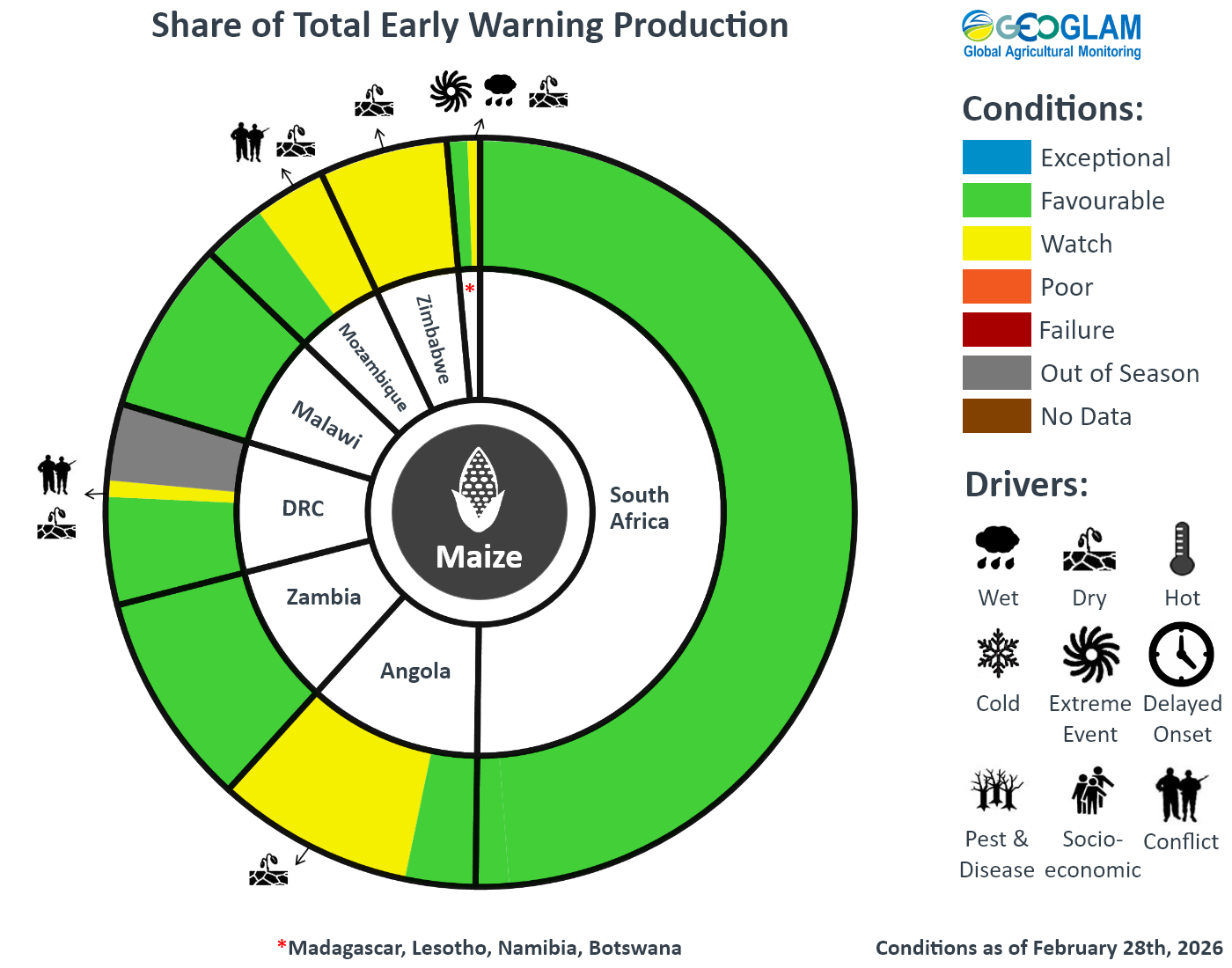
For detailed description of the pie chart please see description box on the bottom of the page.
Regional Outlook: A dry spell in central-southeastern areas and continuation of below-average rainfall in Angola
Most crop growing areas have average or above-average seasonal rainfall totals from October 1st, 2025, to February 20th, 2026 (Figure 1-left). The main exception is western, central, and northern Angola, where drier-than-average conditions have persisted. Rainfall remained below average in Angola over the last month (Figure 1-middle), and rainfall deficits are forecast to deepen during late February and early March (Figure 1-right). Below-average rainfall was also observed in southern DRC and across parts of central-southeastern and southern Africa (Figure 1-middle). Maximum temperatures were above average in the rainfall deficit areas of northern Zimbabwe, central Mozambique, central Angola, and across South Africa.

An extended dry spell during recent weeks has negatively impacted some crops, with higher risks for crops in reproductive stages with high moisture needs and limited access to irrigation. Unofficial field reports in Zimbabwe indicated that crops were drying out under these conditions, however the full impact of the dry spell is unknown. January 21st to February 20th rainfall totals ranged from less than 30 to 60 percent of average in eastern and northern Zimbabwe, central and southern Mozambique, eSwatini, northern South Africa, and portions of southern Madagascar and southern Malawi, based on preliminary rainfall estimates (Figure 1-middle). The intermittent rainfall led to substantially below-average near-surface soil moisture for several weeks in northern Zimbabwe, central Mozambique, northeastern South Africa, and southern Madagascar, based on NASA SMAP soil moisture estimates. Impacts could vary locally, depending on field conditions and soil moisture at crop root levels. Drier and warmer-than-average conditions are forecast during late February in some of the impacted areas. ECMWF forecasts indicate that Zimbabwe and Mozambique may receive above-average rainfall in early March. However, the CHIRPS-GEFS next 15-day forecast from February 26th is more pessimistic, indicating average to below-average rainfall, particularly in eastern zones impacted by the dry spell (Figure 1-right).
Above-average rainfall is forecast in central, northeastern, and some southeastern areas for upcoming weeks, based on the CHIRPS-GEFS 15-day forecast from February 26th (Figure 1-right) and weekly ECMWF forecasts. Above-average rainfall in northern Botswana has reportedly led to flooding of crop fields, and the wet forecast raises the risks of further negative impacts. Earlier this season, severe storms negatively impacted southern Mozambique, where more than 300,000 hectares of cropland were inundated by floodwaters (Reliefweb).
The tropical cyclone season has also had significant impacts on Madagascar. On January 31st, Tropical Cyclone Fytia made landfall in northwestern Madagascar, bringing destructive winds and torrential rainfall. A few days later, Tropical Cyclone Gezani made landfall in the eastern coast of the country, and tracked westward across the country as a tropical storm causing widespread flooding, loss of lives, and displacing tens of thousands of people.
Below-average rainfall and above-average temperatures are forecast in central coastal Mozambique, Madagascar, and northwestern Angola during February 26th to March 12th (Figure 1 right). Longer-range forecasts do not support a clear outlook for rainfall conditions, though some C3S, NMME, and WMO models point to slightly elevated chances of above-normal March-to-May rains in the northeast, including in parts of Zambia, Malawi, and central-western Mozambique. During late March and April, a tapering of seasonal rains is expected in southern parts of the region.

Kariba Dam levels are increasing (to 13.2 percent of usable storage capacity, as of February 26th) but load shedding continues in Zimbabwe and Zambia. Fall Armyworm was noted in several parts of Zimbabwe, although the impacts remain uncertain. In northern Botswana, heavy and persistent rainfall was likely impacting locust control efforts, according to a report on African Migratory Locust and Red Locust Outbreaks.
Figure 1. Seasonal rainfall anomaly, recent rainfall anomaly, and 15-day rainfall forecast anomaly. Left and middle-left panels show CHC Early Estimates. These compare October 1st, 2025, to February 20th, 2026, (left) and January 21st to February 20th, 2026 (middle) precipitation totals to the 1981–2025 CHIRPS averages for respective accumulation periods. Both use CHIRPS3 Preliminary for February 1-20, 2026. Right: Forecast next 15-day precipitation anomaly for February 26th to March 12th, from the CHIRPS3-GEFS forecast, which is a bias-corrected (to CHIRPS v3) version of the NCEP GEFS ensemble mean. Source: UCSB Climate Hazards Center
Central & South Asia
Crop condition map synthesizing Winter Wheat conditions as of February 28th. Crop conditions over the main growing areas are based on a combination of inputs including remotely sensed data, ground observations, field reports, national, and regional experts. Crops that are in other than favourable conditions are labeled on the map with their driver.
In Central & South Asia, winter wheat crops continue to develop across southern Kazakhstan, Kyrgyzstan, Tajikistan, Uzbekistan, Turkmenistan, Afghanistan, and Pakistan, and conditions remain mostly favourable for ongoing crop development. Additionally, forecasts indicate rainfall deficits are likely to continue in many areas through May, and warmer than normal temperatures are expected to reduce snow cover and limit soil moisture recharge (See Regional Outlook Pg. 13). In southern Kazakhstan, conditions remain favourable for ongoing winter wheat development. However, above-average temperatures have resulted in a premature end to dormancy in some areas, increasing the risk of frost damage with low nighttime temperatures. For 2026, the national cropping plan indicates a significant reduction in wheat in favor of fodder, oilseed, and legume crops. Priority is given to highly profitable and drought-resistant crops. In Kyrgyzstan, land preparation for spring crops has begun two weeks earlier than normal due to an unusually warm winter that accelerated the arrival of spring. In Afghanistan, a dry start to the season was followed by rainfall improvements that benefitted healthy germination of sown seeds and contributed to favourable crop development. At the start of the season in October and November 2025, precipitation was significantly below average, with most areas receiving only 30 to 60 percent of normal rainfall. Conditions improved in late December 2025 to early February 2026. From October 2025 to the end of February 2026, cumulative precipitation totals have been below average across most of the country. However, in Badghis, Herat, and Zabul provinces, precipitation was above average during this period. Additionally, cumulative amounts are well above the previous year’s level, except in Nuristan and Kunar provinces located in the east. Both irrigated and rainfed wheat are showing stable growth conditions. The cultivated area for irrigated wheat is near average, while the cultivated area for rainfed wheat remains below average. Overall wheat production is expected to be near average to average this season, but it will depend on precipitation outcomes during March and April, which benefits both irrigated and rainfed areas. Additionally, above-average temperatures have resulted in an early end to crop dormancy, and there is a small risk that cold spots during March and April could damage crops that have prematurely bloomed. The high temperatures, particularly during late January through early March, and recent precipitation during February have also prompted early spring wheat planting, offering the possibility that areas missed during winter cultivation will be recovered in spring. Snow Water Volume (SWV) levels are below average throughout the country, except in Khash Khuspas basin in the southwest where volumes are above average. Additionally, snowpack is in critical condition, threatening irrigation water availability and causing increased risk for second season crops in downstream areas, especially if precipitation remains below-average during March and April. The absence of sufficient surface water increases reliance on groundwater, resulting in significant groundwater extraction for agricultural purposes. Precipitation from March to May is expected to be below average in central and northern areas, and likely higher than normal temperatures will speed the melting of snow during spring (See Regional Outlook Pg. 13). In Pakistan, planting of the mostly irrigated Rabi season wheat crop finalized in December 2025, and planted area is above average, supported by near-record domestic wheat flour prices, adequate soil moisture conditions, and government support measures, including the distribution of high-yielding seed varieties and a planned government purchase of wheat grain of about 2.5 to 3 million tonnes at the minimum support price. Rabi wheat crops are in the vegetative to reproductive stage, and despite below-average precipitation received from October to mid-December 2025, vegetation conditions are near to above average due to adequate irrigation water supply. In the rainfed Barani areas of northern Punjab (20 percent of total wheat plantings), dry weather resulted in some crop losses, though near-average precipitation in late December 2025 and late January 2026 benefitted soil moisture levels and supported crop growth. The outcome of the 2026 Rabi wheat season will depend on rainfall outcomes through April 2026, as abundant amounts are needed to support development and replenish main reservoirs. However, forecast above-average temperatures will increase the risk of crop stress (See Regional Outlook Pg. 13).
Regional Outlook: Extremely poor snow conditions in southern areas, following a very warm February
Seasonal precipitation totals, from October 1st, 2025, to February 20th, 2026, are mainly average to above average in western and central-southern areas and below average in southern, eastern, and northern areas (Figure 1 top-left). Seasonal totals are below average in southern, central, southeastern, and eastern Afghanistan, central and eastern Tajikistan, southern and eastern Kyrgyzstan, and southeastern Kazakhstan. Conversely, seasonal precipitation totals are above average in northwestern Afghanistan, southern and central Turkmenistan, western and eastern Uzbekistan, and southern-central Kazakhstan.
Many areas benefited from above-average precipitation in late January, and in February, mixed conditions were observed. Figure 1 top-middle shows precipitation anomalies for January 21st to February 20th. During late February, drier-than-average conditions occurred in southern areas– in Afghanistan, western Tajikistan, and eastern Uzbekistan– based on CHIRPS preliminary and IMERG data. These precipitation conditions will facilitate land preparation for spring wheat planting by establishing the required level of soil moisture. However, soil moisture has still remained below average in the northern, northeastern, and southern areas of Afghanistan.
Temperatures were much warmer than normal during recent weeks (Figure 1 top-right). The combination of above-freezing temperatures and a lack of major snow storms led to a concerning decline in southern areas' snow water equivalent (SWE) levels during February. Elevated temperatures can result in precipitation falling as rain, rather than as snow, and can also melt existing snow. As of late February, southern region SWE levels are extremely low– these are lower than in any other season on the post-2001 data record (Figure 1 bottom-left). The 2025–2026 snow season began like this, with extremely low SWE levels, following multiple years of hydrologic drought. After a late arrival of substantial storms, storms in late December and late January built up snowpack. The recent poor snow conditions are untimely. Typically, snowpack would substantially increase in February and March. Current forecasts do not indicate the large increases in precipitation necessary to return snowpack to normal levels. This has negative implications for surface water resources later in the year as well as for groundwater recharge, and will likely prompt higher extraction rates.
Seasonal forecasts indicate a combination of dry and hot conditions this spring may occur and elevate risks to rainfed crop production, though there is substantial uncertainty surrounding the distribution and amount of spring 2026 precipitation. During March to May 2026, there are elevated (40 to 50 percent) chances of below-normal precipitation in central-southern areas, including in locations from central and northern Afghanistan to southern Kazakhstan (Figure 1 bottom-middle). There is a high chance that these areas will observe above-normal temperatures (Figure 1 bottom-right), which will speed the melting of snow during spring. During upcoming weeks in March, above-average temperatures are forecast to continue across southern Asia and below-average precipitation is forecast to continue in central and southern Afghanistan. Elsewhere in the region, forecasts are mixed and indicate average to above-average precipitation during early March.
Figure 1. Seasonal rainfall anomaly, recent rainfall anomaly, recent maximum temperature anomaly, regional snow water equivalent, and 3-month tercile probabilities for precipitation and temperature. Top Row: Left and middle-left panels show CHC Early Estimates. These compare October 1st, 2025 to February 20th, 2026, (top-left) and January 21st to February 20th, 2026 (top-middle) precipitation totals to the 1981–2025 CHIRPS averages for respective accumulation periods. Both use CHIRPS3 Preliminary for February 1-20, 2026. Right: Average daily maximum 2m temperature anomaly for January 23rd to February 21st, 2026, compared to a 1991-2020 average. Crosses indicate where these values were highest since 1991. Based on CHIRTS-ERA5 data (bias-corrected ECMWF ERA5T), from UCSB CHC. Bottom Row: Left: Variations in regional Snow Water Equivalent (SWE) (mm) for a domain that encompasses most of Afghanistan and parts of southern Tajikistan and northern Pakistan, in Hindu Kush and Pamir mountain range areas. The dotted line indicates average SWE (2001-2025 period), the blue line shows SWE for Oct. 2024 - Sep. 2025, and the red line shows SWE for Oct. 1st, 2025, to January 27th, 2026. From NASA, using SWE estimates from the FLDAS Central Asia model. Middle and Right: WMO multi-model ensemble probability forecast of March to May 2026 precipitation (bottom-middle) and 2m temperature terciles (bottom-right), based on February initial conditions. Source: UCSB Climate Hazards Center
Southeast Asia
Crop condition map synthesizing rice conditions as of February 28th. Crop conditions over the main growing areas are based on a combination of inputs including remotely sensed data, ground observations, field reports, national, and regional experts. Crops that are in other than favourable conditions are labeled on the map with their driver.
In southern Southeast Asia, planting of wet-season rice is nearing completion, and the total planted area is expected to decrease compared to last season. Harvesting of wet-season rice is also underway, and yield conditions are generally favourable due to sufficient sunlight during the growing period. Additionally, seeding of wet-season maize is nearing completion, and crops are in the vegetative to harvesting stage. Yields are expected to be favourable due to adequate irrigation water availability and sufficient sunlight.
In northern Southeast Asia, the total planted area of dry-season rice is expected to decrease slightly compared to last season. Crops are primarily in the vegetative stage, and growing conditions are generally favourable due to conducive weather conditions and consistent water supply. However, conflict in northwestern Cambodia is expected to reduce the national planted area of dry-season rice. Harvesting of dry-season rice has begun in southern Viet Nam with favourable yield prospects. Additionally, dry-season maize is in the vegetative to harvesting stage. Growing conditions are generally favourable due to adequate sunlight and irrigation water supply, and yields are expected to improve compared to last year due to conducive weather conditions and a lower occurrence of pest and disease outbreaks.
Elsewhere in Southeast Asia, including Sri Lanka, Nepal, and Bangladesh, crops remain under mixed conditions. Concern remains in Sri Lanka where Cyclone Ditwah impacted the country in late November 2025 and may result in yield declines. Additionally, recent drier than normal conditions are impacting crop planting and development in western Nepal. Elsewhere in Nepal and throughout Bangladesh, conditions remain favourable.
In Indonesia, planting of wet-season rice is nearing completion with an accumulated planted area of 5.4 million hectares, which is 5.2 percent lower than the previous wet season. February is the second month of wet-season rice harvesting, covering 1.6 million hectares and progressing faster than the last wet season. The final yield is expected to be favourable due to sufficient sunlight received during the growing period. Additionally, February is the fifth month of wet-season maize seeding, with a planted area of 1.3 million hectares, which is slightly higher than the previous rainy season due to adequate irrigation water availability. February is also the second month of the wet-season maize harvest, with 0.6 million hectares harvested, and the yield is expected to be favourable due to sufficient irrigation water availability and sunlight. In Malaysia, planting of wet-season rice is complete. Growing conditions are generally favourable, although several areas experienced uneven rainfall in early February. Harvesting has begun in some areas, covering 41 percent of the total planted area. Additionally, wet-season maize continues to develop across major producing regions with adequate rains received during the Northeast Monsoon, and field establishment is satisfactory. Crops are mostly at the vegetative to early reproductive stages under favourable conditions. Land preparation is underway for dry-season rice, and planting has begun in several areas, particularly in central Malaysia where 11 percent of the granary areas have been planted. In Brunei, harvesting of wet-season rice is 20 percent complete in irrigated areas, while crops are in the grain filling stage in rainfed areas. Weather conditions are adequate for harvesting activities, and overall crop conditions are favourable.
Crop condition map synthesizing maize conditions as of February 28th. Crop conditions over the main growing areas are based on a combination of inputs including remotely sensed data, ground observations, field reports, national, and regional experts. Conditions that are other than favourable are labeled on the map with their driver.
In the Philippines, dry-season rice planted from November to December 2025 is in the young panicle forming stage, and overall conditions are favourable due to adequate weather conditions and consistent water supply. However, the shear line and tropical cyclones in January 2026 brought heavy rains that caused flooding and landslides in parts of Southern Luzon and Visayas, and the damage is currently under investigation. Additionally, dry-season maize seeded from September to October 2025 is in the harvesting stage, and yield may improve compared to last year due to conducive weather and reduced pest and disease incidence. In Thailand, the total planted area of dry-season rice is 2 million hectares, representing a 2 percent decline compared to last year. Crops are in the young panicle-forming to grain filling stages under favourable conditions due to a consistent supply of irrigation water throughout the growing season, supported by conducive weather conditions. Yields are expected to increase slightly compared to last year. Additionally, dry-season maize is in the harvesting stage, with peak harvest expected to occur during March and April. Both yield and production are expected to increase compared to last year, supported by adequate irrigation systems and the adoption of high-quality seeds. In northern Viet Nam, sowing of dry-season (winter-spring) rice is underway, reaching 181 thousand hectares. However, planting progress is slower than the previous year due to early-season cold spells and prolonged rainfall, which disrupted land preparation and transplanting activities. Additionally, February is the third month of dry-season maize sowing in the north, with a total sown area of 101.3 thousand hectares, which is 6.2 percent lower than the last year. In the south, sowing of dry-season (winter-spring) rice continues with a total sown area of 1.73 million hectares. Growing conditions are favourable, and some provinces, mainly in the Mekong River Delta, have started harvesting. Additionally, 37.8 thousand hectares of dry-season maize have been sown in the south, representing a 2.5 percent decrease year on year. Throughout the country, adequate weather and soil moisture conditions are supporting ongoing planting operations for dry-season maize and early crop development. In Laos, the planted area of dry-season rice has reached 100 percent of the national plan with an area of 98 thousand hectares. Crops are in the seeding and tillering stage, and growing conditions are favourable due to sufficient sunlight and natural water for irrigation in all regions. Production is expected to be 443 thousand tons with an average yield of 4.5 tons per hectare. Additionally, the sown area of dry-season maize reached 7 thousand hectares, which is beyond the national plan of 4.5 thousand hectares. Crops are in the vegetative stage under favourable conditions due to sufficient sunlight and irrigation supply, and production is expected to be 23 thousand tons with a yield of 4.93 tons per hectare. In Myanmar, planting of dry-season rice reached 830 thousand hectares, accounting for 73 percent of the national plan of 1.13 million hectares, and progress is similar to last year. Growing conditions are favourable with conducive weather outcomes, and most crops are now at tillering to panicle-forming stages. Additionally, the seeded area of dry-season maize reached 88.6 percent of the national plan. Crops are in the vegetative stage under favourable growing conditions with normal weather outcomes and good soil moisture. Harvesting has begun with a yield of 3.8 tons per hectare, and the yield is expected to remain favourable if conditions persist. In Cambodia, the planted area of dry-season rice reached 26 thousand hectares, representing a 9 percent decrease compared to the previous year due to conflict in the northwest region. Crops are in the grain filling to harvesting stage, and agro-climatic conditions are favourable due to conducive weather and sunlight. Additionally, sowing of dry-season maize reached 93 percent of the national plan of 27 thousand hectares, representing a 6 percent increase compared to the previous year. Crops are mainly in the reproductive stage with sufficient sunlight, and yield is expected to be favourable.
In Sri Lanka, harvesting of Maha season maize (90 percent of annual maize output) and Maha season rice (60 percent of annual rice output) is just beginning, and there is ongoing concern regarding the prior impacts of Cyclone Ditwah in late November 2025. In Nepal, wheat crops are in the vegetative to reproductive stage, while planting of main season maize is just beginning. Conditions are mostly favourable, except in the west where recent drier than normal conditions may negatively impact yields. In Bangladesh, winter (Rabi season) maize, Rabi season wheat, and Boro season rice (55 percent of annual rice output) are in the vegetative to reproductive stage, and overall growing conditions remain favourable. Harvesting of Rabi season crops will begin in March.
For detailed description of the pie chart please see description box on the bottom of the page.
Central America & Caribbean
Crop condition map synthesizing Beans 3 (Apante season) conditions as of February 28th. Crop conditions over the main growing areas are based on a combination of inputs including remotely sensed data, ground observations, field reports, national, and regional experts. Conditions that are other than favourable are labeled on the map with their driver.
In Central America, Segunda/Postrera season crops are now out of season, and planting for the Primera season will commence in April. Harvesting of second season rice is underway in northern Honduras, and while current vegetation conditions are favourable, a precipitation shortage in the first half of February may reduce water reservoirs and negatively impact yields. In Nicaragua, Apante season beans (35 percent of annual bean production) continue to develop under favourable conditions for harvest in March. In El Salvador, rainfall and temperature forecasts indicate an average start to the Primera season, and land preparation is expected to begin in May. Additionally, the government provision of seeds and fertilizers is expected to increase this year and improve outcomes for smallholder farmers. Throughout Central America, planting for the Primera season will commence in April, though high temperatures may negatively affect the start of sowing due to loss of soil moisture.
In Haiti, harvesting of second season rice is just beginning, and recent wet conditions are negatively impacting harvesting prospects. Conversely, Hiver season bean crops continue to develop under favourable conditions for harvest in March. A combination of residual soil moisture from late December 2025, near-average temperatures, and timely though erratic rains has supported crop growth, particularly in Artibonite, Ouest, Sud-Est, and the Gonaïves area. However, the intermittent rains have also caused pockets of vegetation stress. Throughout the country, protracted conflict and related socio-economic challenges, including limited access to farmland, inputs, and markets, continue to constrain overall production potential. Land preparation for Printemps season beans and main season rice is underway, and planting will begin in April. Current soil moisture conditions are favourable for planting, and forecast generally average rains and average temperatures through March are expected to support adequate water levels in Lac de Péligre and Étang Saumâtre lakes and limit rapid soil moisture depletion. In Cuba, second season maize and rice crops (1/3 of annual rice production) are in the vegetative to reproductive stage, and dry conditions are negatively impacting crop development. Additionally, foreign reserve shortages are limiting the availability of fuel and agricultural inputs, which is likely to reduce yield and production outcomes.
Pie Chart Description: Each slice represents a country’s share of total regional production. The proportion within each national slice is colored according to the crop conditions within a specific growing area; grey indicates that the respective area is out of season. Sections within each slide are weighted by the sub-national production statistics (5-year average) of the respective country. The section within each national slice also accounts for multiple cropping seasons (i.e. spring and winter wheat) and are a result of combining totals from multiple seasons to represent the total yearly national production. When conditions are other than favourable icons are added that provide information on the key climatic drivers affecting conditions.
Information on crop conditions in the main production and export countries can be found in the Crop Monitor for AMIS, published March 5th, 2026.
Sources and Disclaimers: The Crop Monitor assessment is conducted by GEOGLAM with inputs from the following partners FEWS NET, JRC, WFP, ARC, AFSIS, MESA, ICPAC, FAO GIEWS, Applied Geosolutions and UMD. The findings and conclusions in this joint multi-agency report are consensual statements from the GEOGLAM experts, and do not necessarily reflect those of the individual agencies represented by these experts.