
Crop Monitor for AMIS
Report Information
No. 134: Published December 4th, 2025
Conditions as of November 28th
To access all reports, please visit the Archive.
Please visit the Referencing Guidelines page for information on how to cite the Crop Monitor reports and products.
Overview
At the end of November, conditions are overall positive for wheat, maize, rice, and soybeans. For wheat, harvesting is ongoing in the southern hemisphere as winter wheat prepares to enter dormancy in the northern hemisphere. For maize, the harvest is wrapping up in the northern hemisphere as sowing continues to expand in the southern hemisphere. For rice, a strong southwest monsoon and several tropical storms negatively impacted wet-season rice in some northern Southeast Asia countries. For soybeans, the harvest is wrapping up in the northern hemisphere as sowing expands in the southern hemisphere.
Global crop condition map synthesizing information for all four AMIS crops as of November 28th. Crop conditions over the main growing areas for wheat, maize, rice, and soybean are based on a combination of national and regional crop analyst inputs and earth observation data. Crops that are in conditions other than favourable are displayed on the map with their crop symbol.
Crop Conditions at a Glance
Wheat – In the southern hemisphere, the harvest is progressing under favourable to exceptional conditions. In the northern hemisphere, winter wheat sowing is advancing with areas being monitored in Canada, China, Türkiye, Ukraine, and the US.
Maize – Harvesting is wrapping up in the northern hemisphere, with reduced yields in parts of Southeast Asia and Ukraine. Sowing continues to expand in the southern hemisphere.
Rice – In northern Southeast Asia, a strong southwest monsoon and several tropical storms negatively impacted wet-season rice in some countries.
Soybeans – In the northern hemisphere, harvesting is wrapping up as sowing expands in the southern hemisphere.
Forecasts at a Glance
Climate Influences – La Niña conditions are present and will likely subside in early 2026. The combination of negative Indian Ocean Dipole (IOD) and La Niña conditions during October and November 2025 has had some major impacts. In December, IOD conditions will likely return to neutral.
Brazil - The seasonal (3-month) forecasted weather will likely help to resolve dry conditions in northwestern Pará, western Mato Grosso, and Mato Grosso do Sul, while likely exacerbating dry conditions in eastern Pará, western Maranhão, Tocantins, and southern Rio Grande do Sul.
South Africa – The three-month outlook indicates likely above-average precipitation over most of the country, including the summer rainfall regions. Additionally, maximum temperatures are likely to be below-average.
United States – The Seasonal (December 2025 - February 2026) Outlook indicates that above-average precipitation and below-average temperatures are likely in the northern US, while below-average precipitation and above-average temperatures are likely in the southern US.
Wheat Conditions
Wheat crop conditions over the main growing areas are based on national and regional crop analyst inputs and earth observation data. Crop condition information is based on information as of November 28th. Where crops are in conditions other than favourable, the climatic drivers responsible for those conditions are displayed. Crop Season Specific Maps can be found in Appendix 2.
Wheat: In the EU, sowing is mostly complete with crops approaching winter dormancy under generally favourable conditions. In Ukraine, recent warm weather, along with good soil moisture, has helped to advance winter wheat development. In the Russian Federation, winter wheat conditions remain favourable, albeit with an expected reduction in total sown area compared to last year. In Kazakhstan, winter wheat is under favourable conditions. In China, winter wheat sowing is progressing, although with some concern remaining in the North China Plain for total sown area due to earlier heavy rainfall and the delayed autumn crop harvesting. In India, sowing is further along than last year due to supportive October rains and an earlier start to sowing than normal. In the US, winter wheat is under mixed conditions due to areas of dryness in the Pacific Northwest, the Northern Great Plains, and the southern Great Plains. In Canada, winter wheat is under generally favourable conditions, albeit with some areas of low soil moisture. In Australia, harvesting is well underway with exceptionally high yields expected across Western Australia and Queensland. In Argentina, harvest is progressing southward with good overall yields despite localized variability.
For detailed description of the pie chart please see box at the bottom of the page.
Maize Conditions
Maize crop conditions over the main growing areas are based on national and regional crop analyst inputs and earth observation data. Crop condition information is based on information as of November 28th. Where crops are in conditions other than favourable, the climatic drivers responsible for those conditions are displayed. Crop Season Specific Maps can be found in Appendix 2.
Maize: In the US, harvesting is wrapping up with above-average yields expected. In Canada, the harvest is finishing under favourable conditions. In Mexico, the harvesting of the spring-summer crop season (larger season) is beginning under mixed conditions due to earlier excessive rainfall. Sowing of the autumn-winter season (smaller season) is beginning under favourable conditions. In Ukraine, harvesting is progressing under mixed conditions due to prolonged drought and war in the southern and eastern regions. In Brazil, sowing of the spring-planted crop (smaller season) is progressing with a significant increase in total sown area expected compared to last year. In spite of some extreme weather events in the South region, conditions are favourable. In Argentina, the early-planted crop (larger season) is developing under favourable conditions, supported by good soil moisture levels. In South Africa, sowing is underway, supported by ample rainfall since October. In India, sowing of the Rabi crop (smaller season) is beginning. In Indonesia, harvesting of the dry-season crop is progressing as the sowing of the wet-season crop continues.
For detailed description of the pie chart please see box at the bottom of the page.
Rice Conditions
Rice crop conditions over the main growing areas are based on national and regional crop analyst inputs and earth observation data. Crop condition information is based on information as of November 28th. Where crops are in conditions other than favourable, the climatic drivers responsible for those conditions are displayed. Crop Season Specific Maps can be found in Appendix 2.
Rice: In China, the harvest of the late double-crop (medium season) is wrapping up. In India, Kharif rice (larger season) harvesting is progressing into the southern and eastern regions. Sowing of Rabi rice (smaller crop) is in the early stages. In Bangladesh, harvesting of the Aman crop (medium season) is peaking as the sowing of the Boro crop (largest season) begins. In Indonesia, harvesting of dry-season rice is wrapping up as the sowing of wet-season rice slowly continues, as farmers wait for more rain. In Viet Nam, harvesting of summer-autumn rice (wet-season) in the north is finishing. In the south, harvesting of the autumn-winter rice and seasonal rice (wet-season) is also wrapping up as the sowing of dry-season rice begins. In Thailand, wet-season rice is being harvested under mixed conditions due to severe flooding in the northern regions during October. In the Philippines, harvesting is ongoing for wet-season rice under poor conditions due to widespread lodging and flooding caused by several typhoons. In Brazil, sowing is continuing under favourable conditions.
For detailed description of the pie chart please see box at the bottom of the page.
Soybean Conditions
Soybean crop conditions over the main growing areas are based on national and regional crop analyst inputs and earth observation data. Crop condition information is based on information as of November 28th. Where crops are in conditions other than favourable, the climatic drivers responsible for those conditions are displayed. Crop Season Specific Maps can be found in Appendix 2.
Soybeans: In the US, the harvest is wrapping up under favourable to exceptional conditions. In Canada, harvest is completing under favourable conditions and is supported by an increase in total sown area compared to last year. In Brazil, sowing is progressing under favourable conditions despite irregular rain in some regions and extreme weather events, like strong winds and hail in the South region. An increase in total sown area is expected compared to last year. In Argentina, sowing is advancing for the early-planting (typically larger season), albeit with a few delays due to excess soil moisture in some areas. In South Africa, above-average rainfall over the summer rainfall region since October is supporting the sowing efforts.
For detailed description of the pie chart please see box at the bottom of the page.
Pie chart description: Each slice represents a country's share of total AMIS production (5-year average). Main producing countries (representing 95 percent of production) are shown individually, with the remaining 5 percent grouped into the “Other AMIS Countries” category. The proportion within each national slice is coloured according to the crop conditions within a specific growing area; grey indicates that the respective area is out of season. Sections within each slice are weighted by the sub-national production statistics (5-year average) of the respective country. The section within each national slice also accounts for multiple cropping seasons (i.e., spring and winter wheat). When conditions are other than’ favourable’, icons are added that provide information on the key climatic drivers affecting conditions.
Information on crop conditions in non-AMIS countries can be found in the GEOGLAM Crop Monitor for Early Warning.
Climate Influences: La Niña Advisory and Negative IOD
La Niña conditions are present and will likely subside in early 2026. There are 51 percent chances of La Niña during December 2025 to February 2026 and 61 percent chances of neutral ENSO during January to March 2026, according to the CPC/IRI Official ENSO Outlook.
La Niña conditions typically increase the chances of below-average precipitation in East Africa, Central and South Asia, southern South America, the southern United States, northern Mexico, and eastern East Asia, while typically increasing the chances of above-average precipitation in parts of Southeast Asia, Australia, Southern Africa, and northern South America.
Location and timing of likely above- and below-average precipitation related to La Niña events. Based on observed precipitation during 21 La Niña events since 1950, wet and dry correspond to a statistically significant increase in the frequency of precipitation in the upper and lower thirds of historical values, respectively. Statistical significance at the 95% level is based on the resampling of precipitation during neutral El Niño-Southern Oscillation conditions. Source: FEWS NET & NOAA & CHC
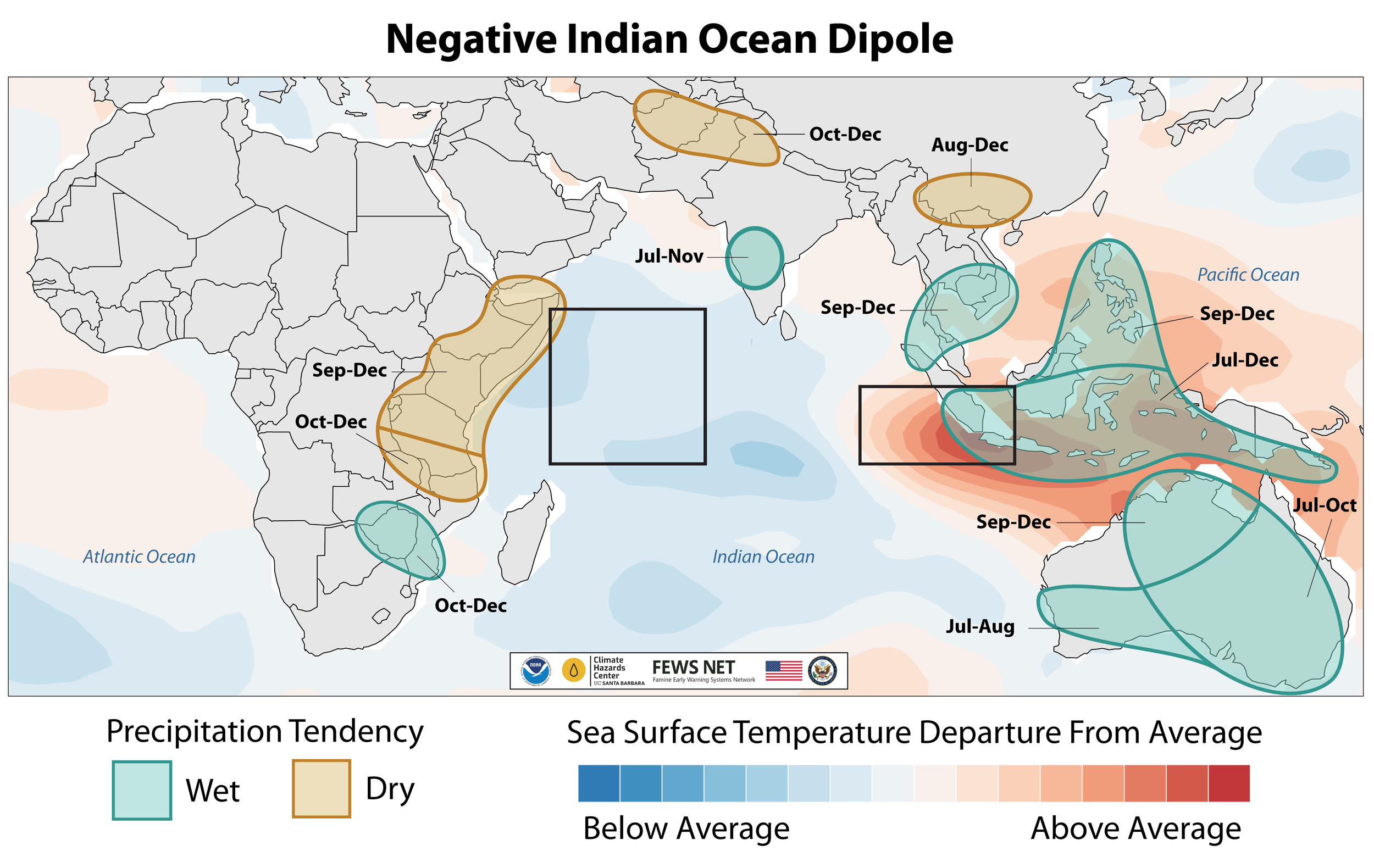
The timing of wet and dry conditions based on Climate Research Unit, CHIRPS, and Global Precipitation Climatology Centre precipitation (green and brown polygons), and sea surface temperature departures from average during July-September (blue and red shading), related to the IOD. The regions used to define the Dipole Mode Index are outlined in black. Source: FEWS NET 2021: IOD and Precipitation, Agroclimatology Fact Sheet Series, Vol. 3, pp. 1-2.
The combination of negative Indian Ocean Dipole (IOD) and La Niña conditions during October and November 2025 severely impacted eastern East Africa’s short rains season, with below-average rainfall, hotter-than-average temperatures, and poor crop and pasture conditions in Somalia and northern and eastern Kenya. Above-average rainfall in the Indo-Pacific region - also consistent with negative IOD and La Niña - was also observed. In December, IOD conditions will likely return to neutral.
Global temperatures for October 2025 were the third warmest on record, according to the Copernicus Climate Change Service Climate Bulletin. Record-breaking maximum temperatures occurred during November in northern Canada, the Middle East, the southern United States, and elsewhere. During December 2025, abnormally cold temperatures are forecast in Canada and the United States. Abnormally hot conditions are forecast across central and eastern Africa, and in western and eastern Australia, northern Argentina, and southwestern and eastern Brazil. Temperatures will likely be warmer than normal in central Asia, Europe, Mexico, and the southern United States.

Source: UCSB Climate Hazards Center
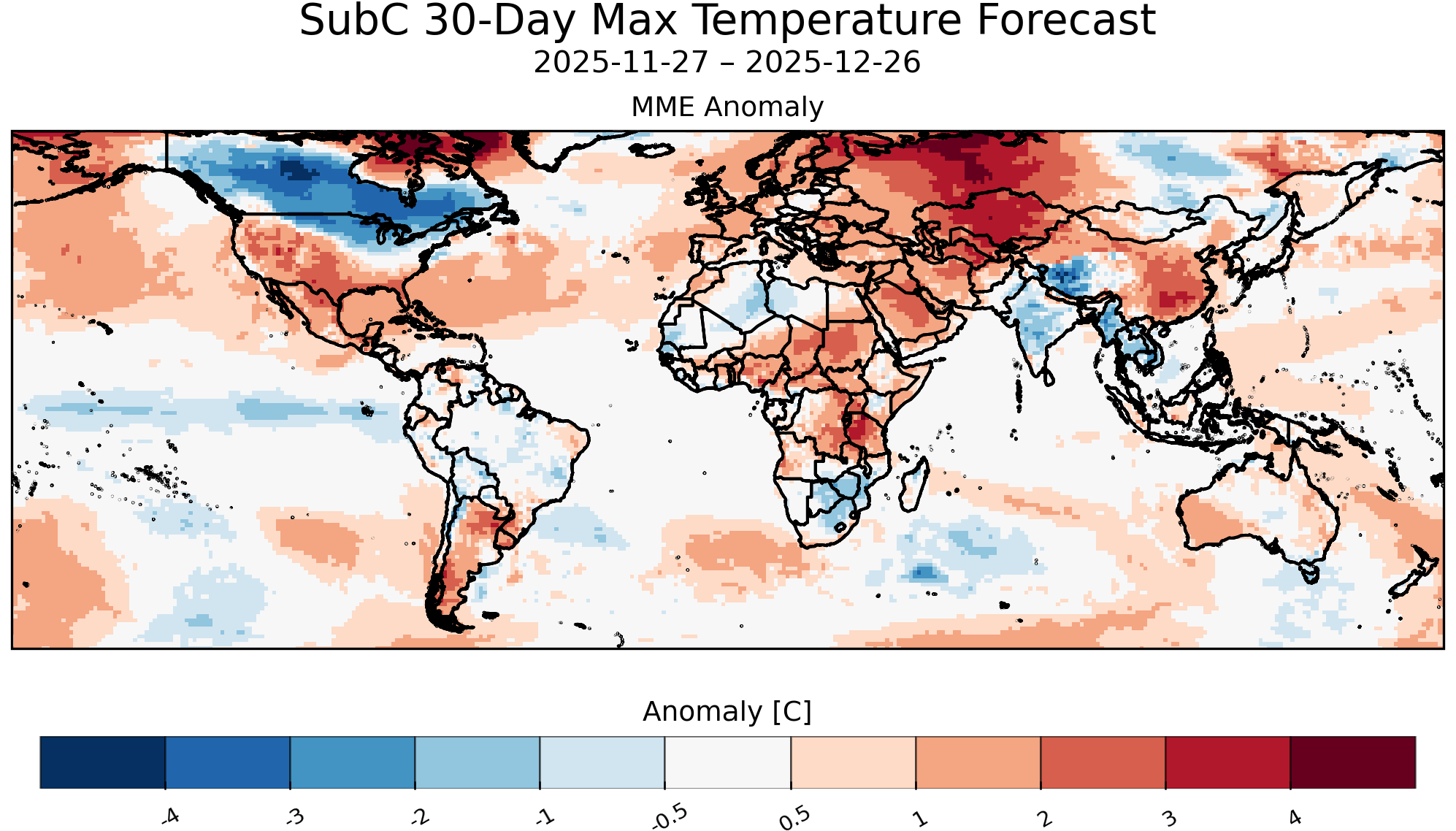
Maximum temperature forecast anomaly for the next 30 days starting on 27 November 2025. Subseasonal Consortium (SubC) model data accessed from the IRI Data Library. Map source: UCSB Climate Hazards Center.
Global Two-week Precipitation Forecast
The two-week forecast (Figure 1) shows a chance of above-average precipitation over southeastern and central west Brazil, northern Bolivia, northwestern Argentina, northern Chile, Ireland, western Norway, northern Sweden, Finland, southern Tunisia, central Libya, southeastern Egypt, Jordan, Iraq, western and southern Iran, northern Saudi Arabia, Liberia, Côte d'Ivoire, southern Ghana, southern Togo, southern Benin, southern and eastern Nigeria, Cameroon, western Central African Republic, Madagascar, central Viet Nam, the Philippines, and central east Australia.
There is also a risk of below-average precipitation over the Canadian Prairies, the southwestern US, central Mexico, northern Honduras, eastern Nicaragua, Costa Rica, Panama, northeastern Colombia, northwestern Venezuela, French Guiana, northeastern and southern Brazil, southern Paraguay, Uruguay, central and eastern Argentina, southern Chile, Portugal, Spain, southern France, northern Italy, Bosnia and Herzegovina, Montenegro, Serbia, Kosovo, Albania, North Macedonia, Bulgaria, southern Romania, central and southern Ukraine, the southern and eastern Russian Federation, northwestern Türkiye, northern Morocco, northern Libya, northern Egypt, southern South Sudan, southern Ethiopia, Somalia, Kenya, Uganda, the Democratic Republic of the Congo, Rwanda, Burundi, Tanzania, northern Mozambique, northern Malawi, northeastern Zambia, southern and northern Angola, Namibia, Kazakhstan, Kyrgyzstan, northern Pakistan, southern India, Sri Lanka, central Mongolia, China, the Democratic People's Republic of Korea, the Republic of Korea, southern Japan, northern Viet Nam, northern Laos, southeastern Indonesia, southern Papua New Guinea, and southern Australia.
Figure 1: IRI SubX Precipitation Biweekly Probability Forecast for 6 – 19 December 2025, issued on 28 November 2025. The forecast is based on statistically calibrated tercile category forecasts from three SubX models. Source: IRI Subseasonal Forecasts Maproom
Brazil Outlook
Currently, seasonal (September 1 – November 20) precipitation deficits exist in the central-west, northern, and very far southern regions. The December–January–February 2025/36 forecast indicates likely above-average precipitation over most of Amazonas, Amapá, most of Pará, western Mato Grosso, Mato Grosso do Sul, Sao Paulo, and northern Parana, while below-average precipitation over western Amazonas, western Acre, northern and southeastern Pará, eastern Mato Grosso, western Maranhão, Tocantins, Bahia, Minas Gerais, Espírito Santo, Santa Catarina, and Rio Grande do Sul. At the same time, temperatures are likely to be above-average over most of the county. These conditions will likely help to resolve dry conditions in northwestern Pará, western Mato Grosso, and Mato Grosso do Sul, while likely exacerbating dry conditions in eastern Pará, western Maranhão, Tocantins, and southern Rio Grande do Sul. .
Upper Left: Seasonal (Sep 1 – Nov 20, 2025) Standardized Precipitation Index. Upper right: Seasonal (Sep 1 – Nov 20, 2025) Seasonal Percent of Normal Precipitation. Lower Left: December 2025 - February 2026 precipitation forecast anomaly. Lower Right: December 2025 - February 2026temperature forecast anomaly. Images from the USDA Crop Explorer and the National Institute of Meteorology of Brazil
South Africa Outlook
The December-January-February 2025/26 outlook indicates likely above-average precipitation over most of the country, including the summer rainfall region, while below-average precipitation is likely over the western Northern Cape/Noord-Kaap, eastern Western Cape/Wes-Kaap, and southern Eastern Cape/Oos-Kaap. At the same time, maximum temperatures are likely to be below-average over most of the country except for the western regions of the Western Cape/Wes-Kaap and the western Northern Cape/Noord-Kaap. Minimum temperatures are likely to be above-average across most of the country, particularly over the western regions of the Western Cape/Wes-Kaap and the western Northern Cape/Noord-Kaap.
Left: December-January-February 2025/26 precipitation anomaly forecast. Center: December-January-February 2025/26 maximum temperature anomaly forecast. Right: December-January-February 2025/26 minimum temperature anomaly forecast. Maps from the South Africa Weather Service
United States Outlook
The seasonal outlook (December 2025 - February 2026) indicates that above-average precipitation is likely in the Pacific Northwest, northern Rocky Mountains, northern Great Plains, upper and middle Mississippi Valley, Great Lakes Region, Ohio Valley, and western Tennessee Valley. In contrast, below-average precipitation is expected along the southern Pacific Coast, Southwest, southern Rocky Mountains, southern Great Plains, Gulf Coast, and southern and middle Atlantic Coast. During this period, temperatures are expected to follow precipitation patterns, with below-average temperatures likely in the north, and above-average temperatures in the south and along the Atlantic Coast. Based on current drought conditions and seasonal weather forecasts, drought conditions are likely to improve or resolve in the Pacific Northwest, northern Rocky Mountains, and much of the Southeast and Northeast. Conversely, drought conditions are expected to develop or worsen in parts of the southern and central Great Plains, High Plains, and Florida.
Upper Left: Seasonal (December 2025 - February 2026) precipitation outlook issued on 30 November 2025. Upper Right: Seasonal (December 2025 - February 2026) temperature outlook issued on 30 November 2025. Bottom: Seasonal (December 2025 - February 2026) drought outlook released on 30 November 2025. Maps from NOAA CPC and NOAA/National Weather Service, National Centers for Environmental Prediction, and Climate Prediction Center.