
Crop Monitor for AMIS
Report Information
No. 135: Published February 5th, 2026
Conditions as of January 28th
To access all reports, please visit the Archive.
Please visit the Referencing Guidelines page for information on how to cite the Crop Monitor reports and products.
Overview
At the end of January, overall conditions are positive for wheat, maize, rice, and soybeans. In the northern hemisphere, wheat crops are mostly in dormancy, with some areas at risk of winterkill. For maize, conditions are generally favourable, although hot and dry weather affects Argentina, and some regions in the Philippines experienced earlier, overly wet weather. Rice conditions are favourable except for dry-season rice in the Philippines. Regarding soybeans, the harvest is beginning in Brazil, but hot and dry weather raises concerns in Argentina.
Global crop condition map synthesizing information for all four AMIS crops as of January 28th. Crop conditions over the main growing areas for wheat, maize, rice, and soybean are based on a combination of national and regional crop analyst inputs and earth observation data. Crops that are in conditions other than favourable are displayed on the map with their crop symbol.
Crop Conditions at a Glance
Wheat – In the northern hemisphere, winter wheat is primarily in dormancy; recent cold weather may have led to some areas of winterkill in parts of Europe and North America.
Maize – Conditions are generally favourable; however, hot and dry weather in Argentina and earlier wet conditions in the Philippines are posing risks to yields.
Rice – Conditions are overall favourable except for dry-season rice in the Philippines.
Soybeans – In the southern hemisphere, hot and dry weather presents concerns in Argentina as the early stages of harvest begin in Brazil.
Forecasts at a Glance
Climate Influences – La Niña conditions were present in January 2026, but will likely return to neutral during February. There are increasing chances that an El Niño event will develop after that, potentially by August to October 2026.
Argentina- The 1-week forecast indicates likely above-average precipitation in the northeast, while below-average precipitation in the southwest. The 3-month forecast indicates likely below-average precipitation in the southern agricultural regions
Brazil – The February outlook indicates mixed precipitation across the country, while temperatures are generally likely to be above-average across most of the country except for in the south and southeast regions.
India – The February outlook indicates below-average precipitation along with above-average minimum and maximum temperatures across most of the country.
Wheat Conditions
Wheat crop conditions over the main growing areas are based on national and regional crop analyst inputs and earth observation data. Crop condition information is based on information as of January 28th. Where crops are in conditions other than favourable, the climatic drivers responsible for those conditions are displayed. Crop Season Specific Maps can be found in Appendix 2.
Wheat: In the EU, conditions are generally favourable, although recent cold spells could have resulted in minor frost kill damage in parts of central and eastern Europe, as well as in the Baltic states. In Türkiye, recent rainfall has improved soil moisture conditions for crops. In Ukraine, unusually cold weather with little to no snow cover in the southern, central, and parts of the eastern regions have lead to possible winterkill conditions, especially for late sown crops. In the Russian Federation, winter wheat conditions remain generally favourable, albeit with winterkill risks from recent cold weather and unfavourable sowing conditions. In Kazakhstan, winter wheat is under favourable conditions. In China, winter wheat remains dormant under favourable conditions. In India, conditions are favourable with an increase in total sown area compared to last year and the five-year average. In the US, winter wheat faces mixed conditions due to several areas experiencing drought, and the potential damage from arctic air north of the snow line from winter storm Fern. In Canada, winter wheat conditions are mixed due to an extreme fall drought during sowing.
For detailed description of the pie chart please see box at the bottom of the page.
Maize Conditions
Maize crop conditions over the main growing areas are based on national and regional crop analyst inputs and earth observation data. Crop condition information is based on information as of January 28th. Where crops are in conditions other than favourable, the climatic drivers responsible for those conditions are displayed. Crop Season Specific Maps can be found in Appendix 2.
Maize: In Mexico, the harvesting of the spring-summer crop season (larger season) is wrapping up under favourable conditions. Sowing of the autumn-winter season (smaller season) is finishing. In Brazil, conditions are favourable as the harvesting of the spring-planted crop (smaller season) begins. There is a significant increase in total sown area compared to last year. Sowing of the summer-planted crop (larger season) is beginning with an expected increase in total sown area compared to last season. In Argentina, areas of high temperatures combined with low rainfall could potentially negatively impact yields of the early-planted crops (larger season), which are in the critical reproductive stage. The sowing of the late-planted crop (smaller season) is in the final stages, and its yields will depend on future rainfall. In South Africa, conditions are favourable with an estimated increase in total sown area compared to last year. In India, the Rabi crop (smaller season) is under favourable conditions. In Indonesia, conditions are favourable due to adequate irrigation water as the sowing of the wet-season crop continues, while the harvesting of earlier sown crops begins.
For detailed description of the pie chart please see box at the bottom of the page.
Rice Conditions
Rice crop conditions over the main growing areas are based on national and regional crop analyst inputs and earth observation data. Crop condition information is based on information as of January 28th. Where crops are in conditions other than favourable, the climatic drivers responsible for those conditions are displayed. Crop Season Specific Maps can be found in Appendix 2.
Rice: In India, transplanting of the Rabi and Summer crops (smaller seasons) is ongoing in the eastern and southern parts of the country under favourable conditions. In Bangladesh, harvesting of the Aman crop (medium season) is wrapping up under favourable conditions as the transplanting of the Boro crop (largest season) is ongoing. In Indonesia, the sowing of wet-season rice is expanding, supported by significant rainfall, as harvest begins for earlier sown crops. In Viet Nam, the sowing of dry-season rice is ongoing in the Mekong River Delta under favourable conditions; however, higher temperatures, reduced rainfall, and saline intrusion over the next few months are risks for crop establishment and early growth. In Thailand, dry-season rice is in the tillering stage with an estimated decrease in total sown area compared to last year due to earlier flooding and lower prices. In the Philippines, conditions are mixed for dry-season rice due to excessive rain during vegetative stages and reports of pests and diseases. In Brazil, conditions are favourable with a reduction in total sown area compared to last year.
For detailed description of the pie chart please see box at the bottom of the page.
Soybean Conditions
Soybean crop conditions over the main growing areas are based on national and regional crop analyst inputs and earth observation data. Crop condition information is based on information as of January 28th. Where crops are in conditions other than favourable, the climatic drivers responsible for those conditions are displayed. Crop Season Specific Maps can be found in Appendix 2.
Soybeans: In Brazil, conditions are favourable as harvest is in the early stages, while the majority of the crop is in the vegetative to reproductive stages. An increase in total sown area is expected compared to last year. In Argentina, sowing is wrapping up for the late-planted crop (smaller season), as the early-planting crop (larger season) enters the critical reproductive stages. Conditions are generally favourable; however, high temperatures and insufficient rainfall in southern Córdoba, La Pampa, and San Luis are raising concerns for yields. In South Africa, conditions are favourable; however, additional rainfall will be needed in the western regions to maintain good crop growth. An increase in total sown area is estimated compared to last year and the five-year average.
For detailed description of the pie chart please see box at the bottom of the page.
Pie chart description: Each slice represents a country's share of total AMIS production (5-year average). Main producing countries (representing 95 percent of production) are shown individually, with the remaining 5 percent grouped into the “Other AMIS Countries” category. The proportion within each national slice is coloured according to the crop conditions within a specific growing area; grey indicates that the respective area is out of season. Sections within each slice are weighted by the sub-national production statistics (5-year average) of the respective country. The section within each national slice also accounts for multiple cropping seasons (i.e., spring and winter wheat). When conditions are other than’ favourable’, icons are added that provide information on the key climatic drivers affecting conditions.
Information on crop conditions in non-AMIS countries can be found in the GEOGLAM Crop Monitor for Early Warning.
Climate Influences: Waning La Niña
La Niña conditions were present in January 2026. La Niña conditions will likely subside during the next month or so. According to the CPC/IRI Official ENSO Outlook, ENSO conditions will most likely be neutral during February to April 2026 (70 percent chance). There are increasing chances that an El Niño event will develop after that, potentially by August to October 2026 (60 percent chance). While long-range forecasts made at this time of year can be unreliable, El Niño events can have widespread, global impacts.
Location and timing of likely above- and below-average precipitation related to La Niña events. Based on observed precipitation during 21 La Niña events since 1950, wet and dry correspond to a statistically significant increase in the frequency of precipitation in the upper and lower thirds of historical values, respectively. Statistical significance at the 95% level is based on the resampling of precipitation during neutral El Niño-Southern Oscillation conditions. Source: FEWS NET & NOAA & CHC
Global temperatures for 2025 were the third warmest on record. 2025 ended with the fifth warmest December and an annual average that was slightly cooler than 2023, according to the Copernicus Climate Change Service Climate Bulletin and Global Climate Highlights. All three of the warmest years on record have been in the past three years. If El Niño conditions develop during 2026, these will likely have a warming effect on global temperatures.
In Australia, where extreme heat occurred during January, February is also forecast to be abnormally hot. February temperatures will likely be warmer than normal in Africa, central and eastern Asia, Brazil, Canada, the Mediterranean, the Middle East, northern Mexico, and the western United States. Abnormally cold conditions are forecast in northern and eastern Europe, western Russia, and the eastern United States during February. Extreme cold weather also impacted these regions during January.
Source: UCSB Climate Hazards Center
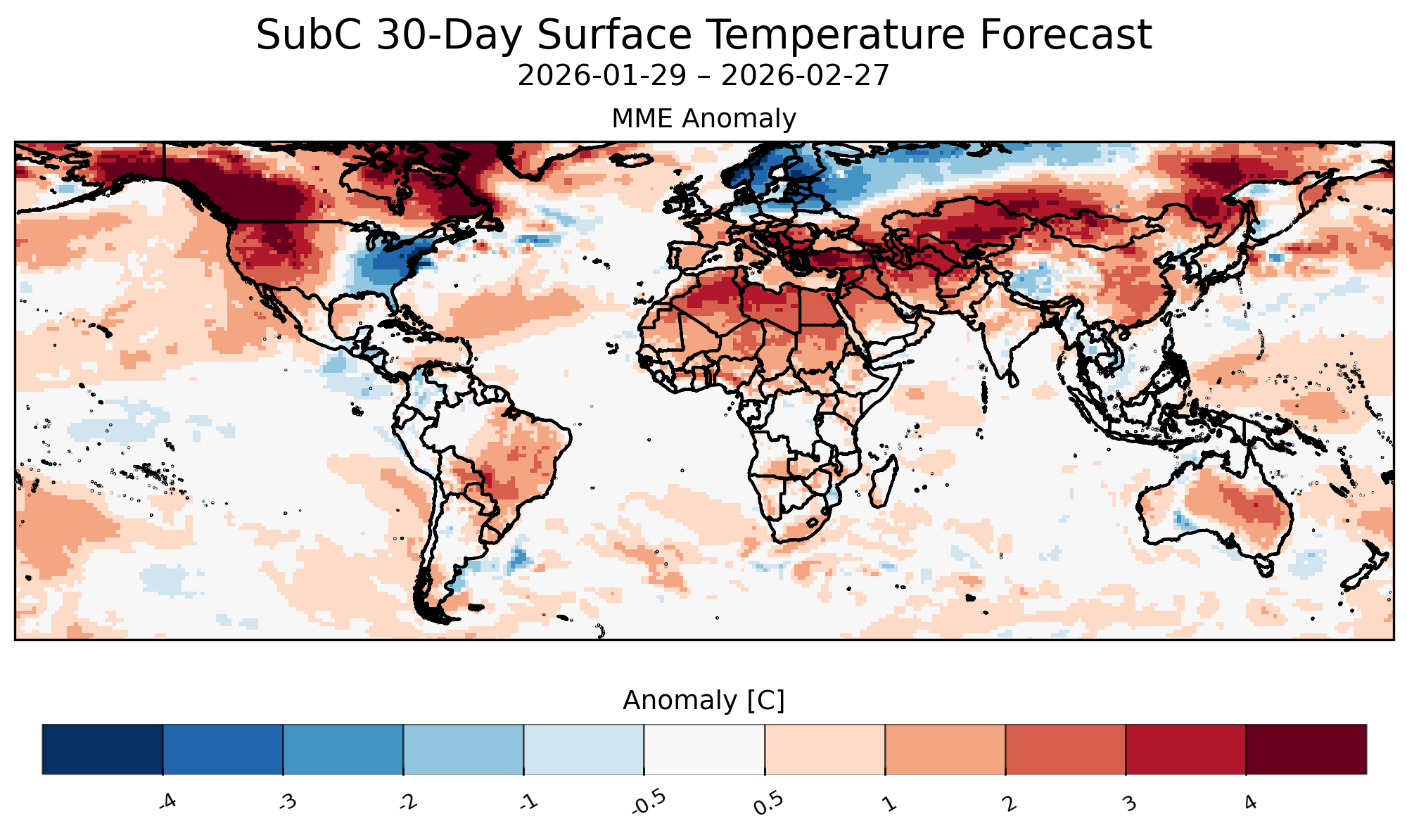
Maximum temperature forecast anomaly for the next 30 days starting on 29 January 2026. Subseasonal Consortium (SubC) model data accessed from the IRI Data Library. Map source: UCSB Climate Hazards Center.
Global Two-week Precipitation Forecast
The two-week forecast (Figure 1) shows a chance of above-average precipitation over northern Quebec in Canada, Haiti, the northern Dominican Republic, Costa Rica, Panama, Colombia, western Venezuela, western Ecuador, northern and southern Peru, Portugal, Spain, southern France, Italy, southern Austria, Slovenia, Croatia, Slovakia, Hungary, Bosnia and Herzegovina, Serbia, Montenegro, Albania, Kosovo, North Macedonia, northern Greece, Bulgaria, Romania, Moldova, Ukraine, the southern and eastern Russian Federation, Liberia, Côte d'Ivoire, southwestern Ghana, southern Nigeria, the northern Democratic Republic of the Congo, Uganda, western Kenya, Rwanda, Burundi, western and central Tanzania, southwest Angola, northern and eastern Kazakhstan, northwestern China, and northern Mongolia.
There is also a risk of below-average precipitation over eastern and western Canada, the Pacific Northwest and the Midwest of the US, Yucatan in Mexico, western Cuba, eastern Venezuela, Guyana, Suriname, French Guiana, northern Brazil, central Bolivia, central Argentina, Ireland, the northwestern UK, Norway, northern Sweden, Finland, Estonia, Latvia, Lithuania, northern Belarus, the northern Russian Federation, southern Zambia, Zimbabwe, central and southern Mozambique, central and eastern China, northeast India, Sri Lanka, southern Japan, southern Viet Nam, Cambodia, southern Thailand, Malaysia, Indonesia, and southern New Zealand.
Figure 1: IRI SubX Precipitation Biweekly Probability Forecast for 7 – 20 February, issued on 30 January 2026. The forecast is based on statistically calibrated tercile category forecasts from three SubX models. Source: IRI Subseasonal Forecasts Maproom
Argentina Outlook
The one-week outlook shows the possibility of above-average precipitation over southern Chaco, eastern Santiago del Estero, Santa Fe, Corrientes, Misiones, Entre Ríos, and northern Buenos Aires, while possible below-average precipitation over San Luis, Mendoza, and La Pampa. During that time, temperatures are likely to be near average in most agricultural areas, except for likely above-average temperatures in the far north and likely below-average temperatures in the southwestern parts of the country. The three-month outlook indicates likely below-average precipitation in Buenos Aires and La Pampa, while likely above-average precipitation over the northwestern region. During this time, temperatures are likely to be above average across most agricultural areas.
Upper Left: 9 – 15 February precipitation forecast anomaly. Upper Right: 9 – 15 February temperature forecast anomaly. Bottom Left: February-March-April 2026 precipitation forecast. Bottom Right: February-March-April 2026 temperature forecast. Images from the National Meteorological Service of Argentina.
Brazil Outlook
The February 2026 outlook indicates areas of above-average precipitation over the north and southeast of the country, while areas of below-average precipitation over the central west and south regions, particularly over eastern and southern Mato Grosso. During the same time, temperatures are likely to be above-average across most of the country except for in the south and southeast regions.
Left: February precipitation anomaly forecast. Right: February 2026 temperature anomaly forecast. Maps from the National Institute of Meteorology (INMET).
India Outlook
The February 2026 precipitation forecast indicates likely below-average precipitation over much of the country except for the northwest and western regions, and central Chhattisgarh. During the same time, minimum temperatures are likely to be above-average over most of the country, except some regions of the South Peninsula, where average minimum temperatures are expected. Above-average maximum temperatures are likely over most of the country except in parts of western and central Madhya Pradesh, northwestern Maharashtra, and the southern parts of the South Peninsula, where average maximum temperatures are likely.
Top: Probability forecast of tercile categories* (below normal, normal, and above normal) for the rainfall during February 2026. Bottom Left: Probability forecast of Minimum Temperature for February 2026. Bottom Right: Probability forecast of Maximum Temperature for February 2026. Maps from the India Meteorological Department.