
Crop Monitor for AMIS
Report Information
No. 140: Published July 2nd 2026
Conditions as of June 28th
To access all reports, please visit the Archive.
Please visit the Referencing Guidelines page for information on how to cite the Crop Monitor reports and products.
Overview
At the end of June, overall conditions are positive for wheat, maize, rice, and soybeans. For wheat, spring wheat is wrapping up in the Northern Hemisphere as winter wheat harvest is progressing. In the Southern Hemisphere, sowing is continuing, albeit with reduced total sown areas expected. For maize, the harvest is proceeding in the Southern Hemisphere as dry conditions develop in parts of the Northern Hemisphere. Rice conditions are generally favourable; however, areas of concern are being watched in India and Thailand. For soybeans, sowing is wrapping up in the Northern Hemisphere.
Global crop condition map synthesizing information for all four AMIS crops as of June 28th. Crop conditions over the main growing areas for wheat, maize, rice, and soybean are based on a combination of national and regional crop analyst inputs and earth observation data. Crops under non-favourable conditions are displayed on the map using their crop symbols.
Crop Conditions at a Glance
Wheat – In the Northern Hemisphere, winter wheat harvesting is continuing. In the Southern Hemisphere, sowing is wrapping up under favourable conditions.
Maize – Harvesting is progressing in the Southern Hemisphere as dryness develops in parts of the Northern Hemisphere.
Rice – Conditions are generally favourable; however, a dry start to the Kharif season in India and the wet-season in Thailand are of concern.
Soybeans – In the Northern Hemisphere, sowing is progressing under generally favourable conditions.
Forecasts at a Glance
Climate Influences – El Niño conditions are present. This will likely be a high-impact event due to its early onset in June 2026 and strong or very strong conditions from September through November 2026 (84% chance).
Europe - As of early June, drought alerts were present across parts of central and eastern Europe, while drought warnings and watches were present across most countries. The July outlook shows likely above-average temperatures across the continent along with possible below-average precipitation over central Europe.
India - The July forecasts indicate likely below-average precipitation across most of the country alongside likely above-average maximum and minimum temperatures.
United States – The July precipitation forecast indicates likely above-average precipitation over northern New England, the central Rockies, the Great Basin, and the Southwest, while below-average precipitation is likely over southern Texas, western Washington, coastal Oregon, North Dakota, and the northern Corn Belt.
Wheat Conditions
Wheat crop conditions over the main growing areas are based on national and regional crop analyst inputs and earth observation data. Crop condition information is based on information as of June 28th. Where crops are in conditions other than favourable, the climatic drivers responsible for those conditions are displayed. Crop Season Specific Maps can be found in Appendix 2.
In the EU, winter wheat is under generally favourable conditions; however, dry soils in central Europe and heatwaves in western Europe might potentially reduce yield prospects. In Türkiye, winter wheat harvesting is ongoing with above-average yields. In Ukraine, winter wheat remains under favourable conditions away from the war front. In the Russian Federation, winter wheat is under favourable conditions. Spring wheat sowing has been completed with a reduction in total sown area compared to last year. In Kazakhstan, conditions are favourable for spring and winter wheat. In China, winter wheat harvest is wrapping up as spring wheat continues to develop. In the US, winter wheat harvest is progressing with below-average yields due to drought in the central and southern Plains. Spring wheat conditions are favourable. In Canada, conditions are favourable as spring wheat sowing wraps up and winter wheat develops. In Australia, sowing is wrapping up under mostly favourable conditions, and a noticeable decline in total sown area is expected compared to last year. In Argentina, sowing is progressing at a good pace, albeit with some delays in the southern agricultural belt due to excess soil moisture.
For detailed description of the pie chart please see box at the bottom of the page.
Maize Conditions
Maize crop conditions over the main growing areas are based on national and regional crop analyst inputs and earth observation data. Crop condition information is based on information as of June 28th. Where crops are in conditions other than favourable, the climatic drivers responsible for those conditions are displayed. Crop Season Specific Maps can be found in Appendix 2.
In Brazil, the harvest of the spring-planted crop (smaller season) is wrapping up as the harvest of the summer-planted crop (larger season) begins. In Argentina, the harvest of the late-planted crop (smaller season) is progressing under favourable conditions. In the US, conditions are favourable, with good emergence and silking. In Canada, conditions are favourable, with good emergence. In Mexico, harvest is ongoing for the autumn-winter crop (smaller season) while sowing of the spring-summer crop (larger season) continues. In China, spring-maize (larger season) is under favourable conditions as sowing of summer-maize (smaller season) continues. In India, sowing of the Kharif crop (larger season) is beginning under mixed conditions due to the slow progress of the Southwest Monsoon. In Indonesia, the harvest of the wet-season crop is wrapping up as sowing of the dry-season crop continues. In the EU, conditions have improved in southeastern Europe, while hot spells in western Europe could negatively affect yields. In Ukraine, conditions are generally favourable, though soils are dry in the eastern and western regions. In the Russian Federation, conditions are favourable.
For detailed description of the pie chart please see box at the bottom of the page.
Rice Conditions
Rice crop conditions over the main growing areas are based on national and regional crop analyst inputs and earth observation data. Crop condition information is based on information as of June 28th. Where crops are in conditions other than favourable, the climatic drivers responsible for those conditions are displayed. Crop Season Specific Maps can be found in Appendix 2.
In China, conditions are favourable for early double-crop rice (smallest season) and for single-season rice (largest season). There is a reduction in total sown area for early double-crop rice compared to last year. In India, sowing of the Kharif crop is beginning under mixed conditions due to the slow-moving Southwest Monsoon. In Bangladesh, the Aus crop (smallest season) develops as sowing continues for the Aman crop (medium season). In Indonesia, harvesting of wet-season rice is finishing as sowing continues for dry-season rice. In Viet Nam, the harvest is ongoing for winter-spring rice (dry-season rice) in the north, while in the south, summer-autumn rice (wet-season rice) is in the sowing and tillering stages. In Thailand, sowing of wet-season rice is continuing under mixed conditions due to drought and reduced fertilizer availability. There is a reduction in total sown area compared to last year due to lower rice prices and rising production costs. In the Philippines, wet-season rice is under favourable conditions.
For detailed description of the pie chart please see box at the bottom of the page.
Soybean Conditions
Soybean crop conditions over the main growing areas are based on national and regional crop analyst inputs and earth observation data. Crop condition information is based on information as of May 28th. Where crops are in conditions other than favourable, the climatic drivers responsible for those conditions are displayed. Crop Season Specific Maps can be found in Appendix 2.
In the US, conditions are favourable with good emergence and blooming. In Canada, sowing is wrapping up under favourable conditions after an initial slow start. There is an increase in total sown area compared to last year. In China, sowing is continuing under favourable conditions. In Ukraine, conditions are generally favourable, though dry soils persist in the eastern and western regions, along with the ongoing war. In India, sowing is just beginning under mixed conditions due to the slow progress of the Southwest Monsoon and dry soils.
For detailed description of the pie chart please see box at the bottom of the page.
Pie chart description: Each slice represents a country's share of total AMIS production (5-year average). Main producing countries (representing 95 percent of production) are shown individually, with the remaining 5 percent grouped into the “Other AMIS Countries” category. The proportion within each national slice is coloured according to the crop conditions within a specific growing area; grey indicates that the respective area is out of season. Sections within each slice are weighted by the sub-national production statistics (5-year average) of the respective country. The section within each national slice also accounts for multiple cropping seasons (i.e., spring and winter wheat). When conditions are other than’ favourable’, icons are added that provide information on the key climatic drivers affecting conditions.
Information on crop conditions in non-AMIS countries can be found in the GEOGLAM Crop Monitor for Early Warning.
Climate Influences: El Niño Watch
El Niño conditions are present. This will likely be a high-impact event due to its early onset in June 2026 and strong or very strong conditions from September through November 2026 (84% chance, according to the June 2026 NOAA CPC ENSO outlook). The odds of it ranking among the strongest events on record are relatively high, with a 63% chance of very strong El Niño conditions from November 2026 through January 2027. The event will remain active at least through March 2027.
El Niño events tend to enhance rainfall in Central Asia, southern North America, south-eastern South America, southern Europe, eastern and southern East Africa, and southern and eastern China. Drier-than-average conditions tend to occur in Central America, the Caribbean, northern South America, parts of western and northern East Africa, the Sahel region, Southern Africa, India, Northern China, the Maritime Continent, and Australia.
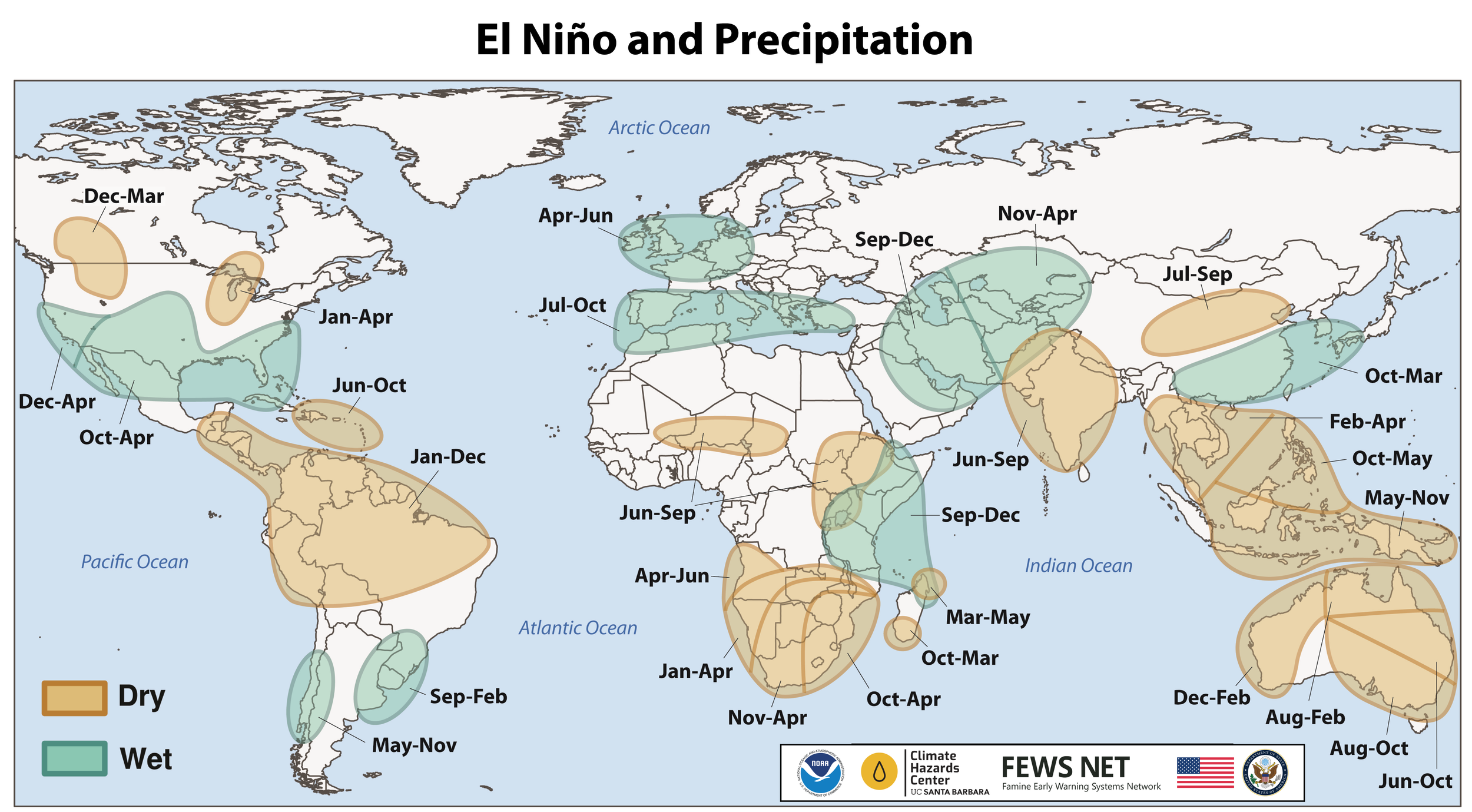
Location and timing of likely above- and below-average precipitation related to El Niño events. Based upon observed precipitation during 22 El Niño events since 1950, wet and dry correspond to a statistically significant increase in the frequency of precipitation in the upper and lower thirds of historical values, respectively. Statistical significance at the 95% level is based on the resampling of precipitation during neutral El Niño-Southern Oscillation conditions. Source: FEWS NET & NOAA & CHC
Positive Indian Ocean Dipole (IOD) conditions are also forecast, with potential for a strong event during October to December 2026. A positive IOD tends to enhance the drying influence of El Niño in Australia and the Maritime Continent and substantially increase the chances of a wet and intense East African short-rain season.
Global temperatures for June 2026 were the second warmest on record, according to the Copernicus Climate Change Service Climate Bulletin. The likelihood of extreme conditions during the coming year will increase as El Niño warms global temperatures.
During late June through early July 2026, abnormally hot temperatures are forecast in agricultural areas of the central and southeastern United States, coastal and northeastern Mexico, Central America, the Caribbean, northern Colombia, Europe, the Sahel region, East Africa, India, northern Pakistan, southeastern Afghanistan, central Asia, northern China, and Myanmar (Figure 1). East Africa, India, southern Europe, parts of the southwestern United States, and Southeast Asia were impacted by heat earlier in June.
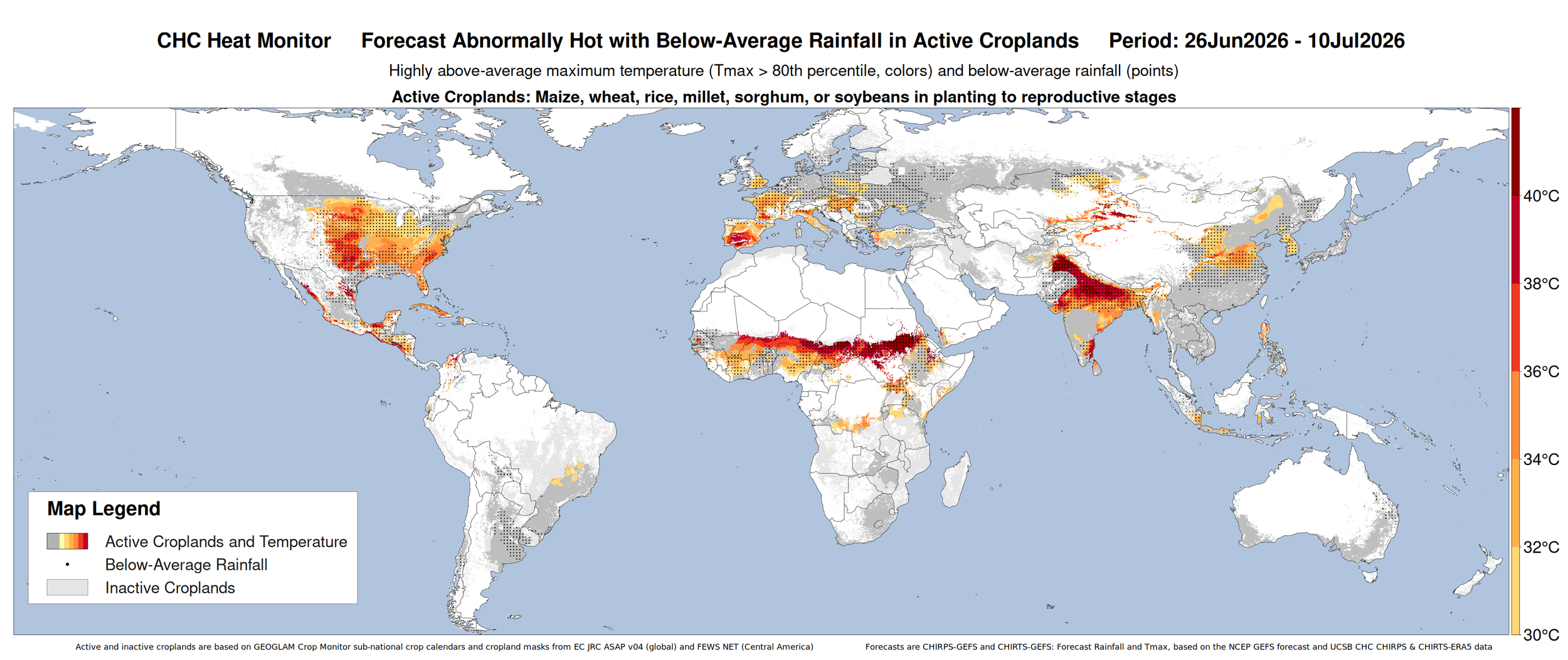
CHC AgriHeat Forecast for June 26 to July 10, 2026. Forecast 15-day average maximum temperatures are shown where they will be abnormally hot (Tmax > 80th percentile and > 30 C) and in active crop-growing areas. Areas with forecasted below-average rainfall for this period are also identified. Based on a 15-day CHIRTS-GEFS forecast from June 26, 2026. From UCSB Climate Hazards Center. Map source: UCSB Climate Hazards Center
Source: UCSB Climate Hazards Center
El Niño 2026-2027: Anticipated Climate and Agricultural Yield Impacts
The GEOGLAM Crop Monitors published a special report on El Niño 2026-2027: Anticipated Climate and Agricultural Yield Impacts on June 16th, 2026. The full report is available on the GEOGLAM Crop Monitor website. The report details the likely global and regional climatic impacts and how crop yields for wheat, maize, rice, and soybeans will be affected. Some highlights are listed below.
● Stronger El Niño events lead to more predictable, though usually not more severe, crop yield outcomes.
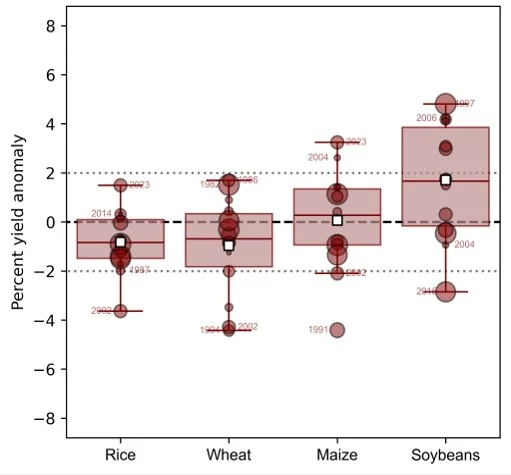
● At the global scale, past El Niño events tend to decrease rice yields the most, with yields being about 1.0 to 1.5% below trend, while soybean yields tend to increase the most, with yields being about 1.5 to 2.0% above trend.
● Regionally, Central Asia, bimodal East Africa, southern South America, and the US are likely to see the most positive crop yield impacts, while Southern Africa, Central America, India, and Australia are likely to see the most negative crop yield impacts.
Global-scale yield anomalies relative to expected yields during past El Niño events. Boxplots show the interquartile range and median of the yield anomalies, with the mean denoted by a white square. The size of each point corresponds to the strength of El Niño during Oct-Dec of that year. Source Data: FAOSTAT data and NOAA CPC Relative Oceanic Niño Index data.
Global Two-week Precipitation Forecast
The two-week forecast (Figure 1) shows a chance of above-average precipitation over the western US, northwestern Mexico, northern French Guiana, Central West Brazil, northeastern Bolivia, northern Chile, central Spain, southern Italy, southern Albania, North Macedonia, Greece, southern Bulgaria, northern Norway, northern Sweden, northern Finland, the northwestern and eastern Russian Federation, northern Algeria, northeastern Morocco, northwestern Uganda, central Tanzania, central and northern Kazakhstan, eastern Kyrgyzstan, central India, eastern Mongolia, southern and northeast China, the Democratic People’s Republic of Korea, northern Japan, western Laos, northeastern Cambodia, and northeastern Viet Nam.
There is also a risk of below-average precipitation over central and western Canada, the central US, southern Mexico, Guatemala, El Salvador, Honduras, western Nicaragua, Cuba, Haiti, the Dominican Republic, western Colombia, eastern Venezuela, northern Ecuador, central Peru, northern Brazil, southeastern Bolivia, western Paraguay, northern Argentina, southern Chile, Ireland, the United Kingdom, northern France, Belgium, the Netherlands, Germany, Denmark, eastern Poland, southern Sweden, Belarus, Ukraine, the western Russian Federation, northern Romania, Slovakia, eastern Hungary, northern Servia, northcentral Türkiye, southern Mauritania, Senegal, Mali, northern Guinea, Guinea-Bissau, Côte d'Ivoire, Burkina Faso, Ghana, Togo, Benin, Niger, Nigeria, Chad, the northern Central African Republic, Sudan, northern South Sudan, Eritrea, central and northern Ethiopia, southern Somalia, southern Tanzania, central Mozambique, eastern Kazakhstan, Pakistan, southern and western India, Sri Lanka, northern Bangladesh, Bhutan, central and northwestern China, southern Mongolia, southern Japan, southern Myanmar, central Thailand, western Cambodia, the southern Philippines, Malaysia, Indonesia, Papua New Guinea, and eastern Australia.
Figure 1: IRI SubX Precipitation Biweekly Probability Forecast for 4 – 17 July 2026, issued on 26 June 2026. The forecast is based on statistically calibrated tercile category forecasts from three SubX models. Source: IRI Subseasonal Forecasts Maproom
Europe Outlook
In Europe, drought alerts as of early June exist over parts of the southern United Kingdom, south-western Spain, central-western France, southern Germany, Poland, Lithuania, Latvia, southern Estonia, Belarus, central and western Ukraine, Slovakia, Hungary, western Czechia, eastern Austria, western Romania, western and northern Italy, and North Macedonia. Additionally, drought warnings and watch conditions cover parts of most countries.
The July 2026 outlook indicates likely above-average precipitation over parts of southeastern Spain, southwestern Greece, and southern Türkiye, while below-average precipitation is likely over Ireland, the United Kingdom, Belgium, the Netherlands, Germany, Denmark, southern Norway, southern Sweden, Poland, Lithuania, Czechia, Austria, Slovakia, Hungary, western Belarus, western Ukraine, northern Macedonia, northern Romania, Serbia, eastern Slovenia, Croatia, and Bosnia and Herzegovina. During this time, temperatures are highly likely to be above-average across all of Europe, with the highest likelihood over southern Europe, central Europe, and the Balkans.
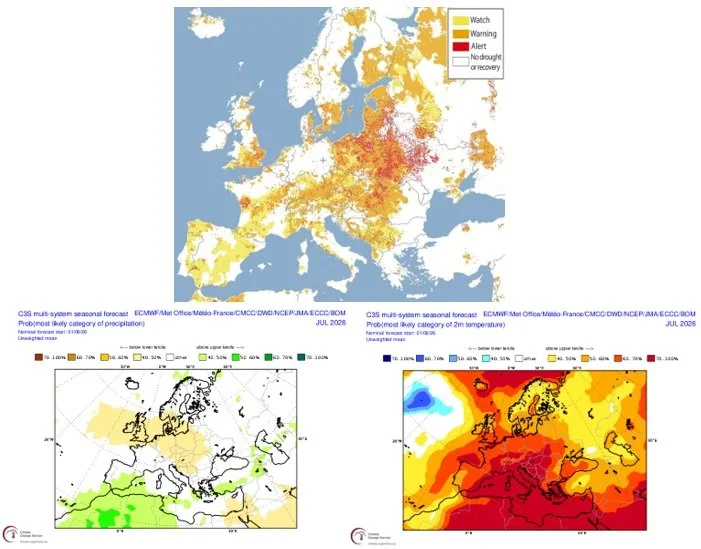
Top: 1-10 June 2026 drought conditions over Europe from the European Drought Observatory. Bottom Left: July 2026 precipitation probability forecast. Bottom Right: July 2026 temperature probability forecast. Maps from the Copernicus Climate Change Service
India Outlook
As of June 24th, drought conditions are present across northern, northeastern, eastern, central, and western parts of the country (top). The Southwest Monsoon (bottom left) has had a weak start and has been moving behind the normal schedule of advancement. As of July 1st, the Southwest Monsoon has yet to cover the western parts of the country. Overall precipitation from the 2026 Southwest Monsoon is forecasted to be below-average (90%) from the long-term average.
The July forecast calls for below-average precipitation (<94% of the long-term average) over the country (bottom middle). Regionally, only the northwest, northeast, central-east, and eastern peninsular regions are likely to see above-average precipitation. During this time, both the maximum (bottom right) and minimum temperatures are likely to be above-average across most of the country, except for isolated pockets.
Top: Combined Drought Index (CDI) for the week ending June 25, 2026, from the India Drought Monitor. Bottom Left: Advancement of the 2026 Southwest Monsoon as of July 1, 2026. Bottom Middle: Probable precipitation forecast for July 2026. Bottom Right: Probable maximum temperature forecast for July 2026. Source: India Meteorological Department
United States Outlook
The July 2026 precipitation forecast indicates likely above-average precipitation over parts of northern New England, the central Rockies, the Great Basin, and the Southwest, while below-average precipitation is likely over southern Texas, western Washington, coastal Oregon, North Dakota, Minnesota, northern Wisconsin, and northern Michigan. At the same time, temperatures are likely to be above average across most of the country except over the Corn Belt and the Northern Plains, where chances are equal for above- or below-average temperatures.
The impacts of July’s weather outlook are the likely development or expansion of drought conditions over parts of the Pacific Northwest, northern California, western Kansas, and eastern Texas. At the same time, drought conditions are likely to improve or be removed over parts of the northern Corn Belt, the Southwest, the Southeast, and coastal New England.
Upper Left: July 2026 precipitation outlook issued on 30 June 2026. Upper Right: July 2026 temperature outlook issued on 30 June 2026. Bottom: July 2026 drought outlook released on 30 June 2026. Maps from NOAA CPC and NOAA/National Weather Service, National Centers for Environmental Prediction, and Climate Prediction Center.