
Crop Monitor for Early Warning
Report Information
No. 114: Published April 2nd, 2026
Conditions as of March 28th
For access to all reports, please visit the Archive.
Please visit the Referencing Guidelines page for information on how to cite the Crop Monitor reports and products.
Overview
In East Africa, planting of Belg/main season cereals continues under generally favourable conditions with recent rainfall improvements.
In West Africa, land preparation and planting for the 2026 main season are ramping up with good rains received across southern areas.
In the Middle East & North Africa, winter wheat continues to develop under mixed conditions as delayed rains at the beginning of the season were followed by improvements from November 2025 to early 2026 that benefitted some areas.
In Southern Africa, agro-climatic conditions are mostly favourable for main season cereals following rainfall improvement in mid-March, except in parts of Angola, Zimbabwe, and Madagascar.
In Central & South Asia, winter wheat crops continue to develop under favourable conditions, and land preparation and planting for spring wheat are just beginning in some areas.
In Southeast Asia, conditions remain generally favourable for dry-season crops in the south and wet-season crops in the north, except in Cambodia and northern Viet Nam.
In Central America & the Caribbean, harvesting of Apante season bean crops finalized in March under favourable conditions. Land preparation is underway for the Primera season, which will commence in April.
Crop Conditions at a Glance
Crop condition map synthesizing information for all Crop Monitor for Early Warning crops as of March 28th. Crop conditions over the main growing areas are based on a combination of inputs including remotely sensed data, ground observations, field reports, national, and regional experts. Regions that are in other than favourable conditions are labeled on the map with a symbol representing the crop(s) affected.
EAST AFRICA: Planting of Belg/main season cereals continues under generally favourable conditions as recent rains have mitigated prior dry concerns in Ethiopia and bimodal areas of the United Republic of Tanzania. Forecast above-average rains through June are expected to further benefit cropping outcomes (See Regional Outlook Pg. 6).
WEST AFRICA: Land preparation and planting for the 2026 main season continue under generally favourable conditions, except in conflict affected areas. Southern areas have received substantial precipitation that is expected to continue through May.
MIDDLE EAST & NORTH AFRICA: Winter wheat continues to develop under mixed conditions, and concern remains in parts of Algeria, Libya, Syria, and Iran due to early season rainfall deficits and planting delays. In the Middle East, escalating regional conflict and related supply chain disruptions are driving up fuel and fertilizer prices.
SOUTHERN AFRICA: Harvesting of main season cereals is just beginning or will start from April, and while recent rains in mid-March resulted in crop recovery in some areas, dry concerns remain in parts of northwestern Angola, Zimbabwe, and parts of Madagascar (See Regional Outlook Pg. 13). Additionally, concern remains in parts of central and eastern Madagascar due to recent cyclone impacts.
CENTRAL & SOUTH ASIA: Winter wheat crops continue to develop under favourable conditions with sufficient snow coverage and adequate soil moisture levels. Land preparation and planting of spring wheat are just beginning in parts of Kyrgyzstan and Afghanistan.
SOUTHEAST ASIA: Conditions remain generally favourable for dry-season rice and maize crops in the south and wet-season rice and maize crops in the north, except in Cambodia where ongoing conflict may constrain final dry-season rice yields and in northern Viet Nam where there were delays for dry-season maize. Planting of dry-season rice is now underway in Brunei and Malaysia.
CENTRAL AMERICA & CARIBBEAN: Harvesting of Apante season beans finalized in Honduras and Nicaragua under favourable conditions, and land preparation is now underway for the Primera season across Central America. Forecasts indicate likely above-average rains for the start of the Primera season, followed by a shift to below-average amounts from May to July (See Regional Outlook Pg. 19).
Global Climate Outlook: Two-week forecast of areas of above or below-average precipitation
The two-week forecast (Figure 1) shows a chance of above-average precipitation over the southern and northern Midwest of the US, northeastern and southwestern Mexico, eastern Nicaragua, Costa Rica, eastern Panama, northern Colombia, Venezuela, northern Guyana, northern Suriname, northern French Guiana, southwestern Peru, northern Chile, northeastern Brazil, southern Italy, eastern Serbia, southwestern Romania, Bulgaria, North Macedonia, Greece, western and southern Türkiye, northern Syria, northern and western Iraq, northeastern and southwestern Iran, Qatar, the United Arab Emirates, eastern Oman, western Yemen, central Saudi Arabia, Jordan, northern and central Egypt, northern Libya, northern Algeria, Burkina Faso, northern Ghana, Togo, Benin, Nigeria, southern Chad, northern Cameroon, the northern Central African Republic, southern Sudan, northern South Sudan, northwestern Ethiopia, northwestern Angola, central South Africa, central Mozambique, northeastern Tanzania, southern Kazakhstan, Uzbekistan, western Kyrgyzstan, western Tajikistan, eastern Turkmenistan, Afghanistan, Pakistan, western and northcentral India, Nepal, Bangladesh, southern China, and the northeastern Russian Federation.
There is also a risk of below-average precipitation over northeastern Canada, the western US, central Bolivia, Paraguay, southern and southeastern Brazil, northern Argentina, central Chile, Ireland, the United Kingdom, northern Portugal, northwestern Spain, France, Switzerland, Belgium, the Netherlands, western Germany, Denmark, southern Norway, central Sweden, Finland, Estonia, Latvia, northern Belarus, the northwestern Russian Federation, northwestern Romania, eastern Hungary, Slovakia, northcentral Saudi Arabia, southern Ethiopia, southern Somalia, Kenya, Uganda, southern South Sudan, Rwanda, Burundi, northern Tanzania, northern Madagascar, northern Mongolia, northwestern and northeastern China, the Democratic People's Republic of Korea, southern and northern Japan, the Philippines, southern Viet Nam, Cambodia, Thailand, eastern Myanmar, Malaysia, northern and eastern Indonesia, Papua New Guinea, and northern and eastern Australia.
Figure 1: IRI SubX Precipitation Biweekly Probability Forecast for 4 – 17 April, issued on 27 March 2026. The forecast is based on statistically calibrated tercile category forecasts from three SubX models. Source: IRI Subseasonal Forecasts Maproom
Climate Influences: Waning La Niña and El Niño Watch
La Niña conditions were present during March 2026. Neutral ENSO conditions are expected during April and May, with El Niño likely to develop shortly after. According to the March 2026 NOAA CPC ENSO outlook, El Niño criteria will likely be met during June to August 2026 (62 percent chance), and the event will persist through the end of 2026 (83 percent chance for October to December 2026). While long-range forecasts made at this time of year can be unreliable, El Niño events can have widespread, global impacts.
Global temperatures for February 2026 were the fifth warmest on record, according to the Copernicus Climate Change Service Climate Bulletin. If El Niño conditions develop during 2026, these will likely have a warming effect on global temperatures.
Abnormally hot temperatures occurred during March 2026 in portions of western and eastern Australia, El Salvador, western and central India, southern Madagascar, northwestern Mexico, South Africa, and the southwestern United States. During late March through mid-April 2026, above-average temperatures are forecast in South Africa, the eastern Sahel region, across central, northern, and eastern Asia, western Australia, southern-central South America, northern Mexico, and the United States. Below-average temperatures are forecast in central and eastern Canada, northern Africa, and the Middle East.
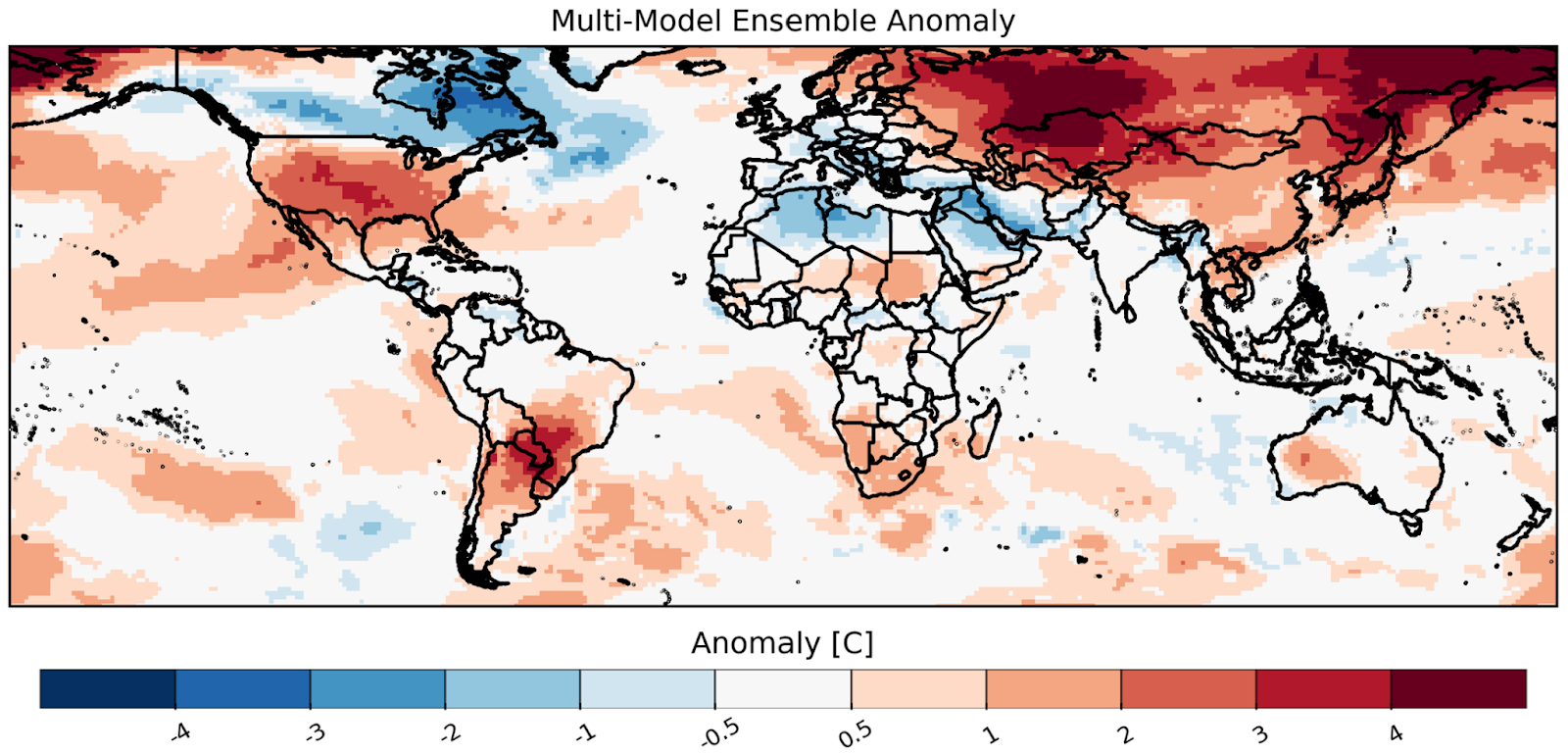
Figure 1. Average temperature anomaly forecast for the next 30 days starting on 26 March 2026, from four Subseasonal Consortium (SubC) models. SubC data accessed from the IRI Data Library. Map source: UCSB Climate Hazards Center.
East Africa
Crop condition map synthesizing Maize 1 crop conditions as of March 28th. Crop conditions over the main growing areas are based on a combination of inputs including remotely sensed data, ground observations, field reports, national, and regional experts. Conditions that are other than favourable are labeled on the map with their driver.
Across northern East Africa, winter wheat harvesting is underway in Sudan with continuing concern due to ongoing conflict related disruptions. In Ethiopia and Yemen, planting of Belg/main season cereals is just beginning under favourable conditions. Recent rains have mitigated prior dry concerns in Ethiopia but also triggered landslides and flooding in the southwest.
Across southern East Africa, harvesting of short rains maize finalized in Kenya with failure outcomes expected in bimodal and minor producing regions in the eastern half of the country and poor outcomes expected in the centre due to persistent dry and hot conditions this season. Conversely, favourable outcomes are expected in the unimodal and major producing regions in the eastern half of Kenya. In the United Republic of Tanzania, planting and development of main season cereals continues, and while erratic rains at the beginning of the season continue to impact Msimu season crops in unimodal central and southern areas, recent rains helped to partially mitigate prior dry concerns, and forecast abundant rains through April are expected to further improve conditions. Planting of main season cereals is just beginning across Burundi, Rwanda, Uganda, and Kenya under favourable conditions due to favourable and above-average rains in March. In many areas, an early onset of seasonal rains of up to a month in mid-February was generally beneficial for planting activities but resulted in flooding and landslides in some areas, including in Belg producing areas of Ethiopia and the southern Rift Valley in Kenya. Forecast average to above-average precipitation through June over most areas is expected to benefit cropping outcomes; however, heavy rains may lead to flooding, particularly in areas where soils are already saturated (See Regional Outlook Pg. 6).
Crop condition map synthesizing Sorghum 1 conditions as of March 28th. Crop conditions over the main growing areas are based on a combination of inputs including remotely sensed data, ground observations, field reports, national, and regional experts. Conditions that are other than favourable are labeled on the map with their driver.
Northern East Africa & Yemen
In Sudan, winter wheat harvesting is just beginning, and ongoing insecurity continues to diminish production capacity. In South Sudan, land preparation is underway for first season cereals, and planting will begin in April. In Ethiopia, planting of Belg season maize is underway, and recent rains have mitigated prior dry concerns. However, heavy rainfall reported across the Former SNNRP region in the southwest triggered landslides and flooding. Forecast above-average rains during late March to early April will increase the risk of floods in landslides in southwestern areas where soils are already saturated (See Regional Outlook Pg. 6). Additionally, in localized parts of Amhara region, clashes between armed groups are causing disruptions to planting operations. Land preparation and planting for the Meher season will begin in May. The forecast El Niño event is expected to have negative implications for the upcoming Meher season (See Climate Influences Pg. 3). During past years with similar El Niño conditions, both maize and sorghum yields were below normal, with the greatest losses in eastern Amhara, Tigray, and northeastern Oromia, while losses in the western regions were less severe. National deficits were -2 percent of average, with potential deficits exceeding -10 to -15 percent. In Yemen, sorghum planting began in March with the onset of the March to May rainy season under favourable conditions. However, prolonged economic constraints and protracted conflict will continue to undermine planting operations and production prospects.
Crop condition map synthesizing Maize 2 conditions as of March 28th. Crop conditions over the main growing areas are based on a combination of inputs including remotely sensed data, ground observations, field reports, national, and regional experts. Conditions that are other than favourable are labeled on the map with their driver.
Southern East Africa
In Somalia, land preparation is underway for the Gu season, and planting will begin in April with the start of the April to June Gu rains. Above-average Gu rains will be critical following the failed October to December 2025 Deyr rainfall season. Forecasts indicate potential above-average precipitation amounts in central to southern and northwestern areas through June (See Regional Outlook Pg. 6). In Kenya, harvesting of short rains cereals finalized in March with poor to failure outcomes expected in the bimodal and minor producing eastern half of the country due to an exceptionally dry short rains season and high temperatures. Conversely, favourable outcomes are expected in the unimodal and major producing western half of the country. Planting of both long rains cereals and second season rice continues under favourable conditions. In bimodal areas of Uganda, planting of first season maize and millet continues under favourable conditions. In Rwanda and Burundi, planting of Season B maize and rice crops continues under favourable conditions. In the United Republic of Tanzania, planting and development of Masika (bimodal regions) and Msimu (unimodal regions) crops continue. In central and southern unimodal rainfall areas, erratic rains between November 2025 and January 2026 negatively impacted Msimu season crop planting and establishment, resulting in below-average vegetation conditions. However, recent rainfall improvement in March helped to partially mitigate previous dry concerns. Conversely, conditions for Masika crops improved in bimodal northern regions, and forecast abundant rains through April are expected to further improve conditions throughout the country (See Regional Outlook Pg. 6).
For detailed description of the pie chart please see description box on the bottom of the page.
Regional Outlook: Above-average rainfall received across most of the region during March with mixed conditions forecast in April
March 1st to 20th rainfall (Figure 1 top-left) was above average across many equatorial and southern areas—in Tanzania, Kenya, Uganda, Rwanda, South Sudan, and southwestern and central Ethiopia. Following weeks of heavy rains, large surpluses of more than 200 mm were recorded in localized areas of southwestern Ethiopia, western, southwestern and central Kenya, and parts of northeastern and southwestern Tanzania. Such wet conditions seldom occur during early to mid-March in many of these areas. According to preliminary rainfall estimates, portions of southwestern Ethiopia, western Kenya, and Tanzania received their highest March 1st to 20th rainfall on record, since at least 1981.

Intensification of rainfall from mid-late February supported an early onset of the seasonal rains in Kenya, South Sudan, northern Uganda, and locations in southwestern Ethiopia. Elsewhere in southwestern-central Ethiopia, substantial rains arrived in March following a drier-than-average February. Favorable moisture conditions, indicated by average to above-average Water Requirement Satisfaction Index values and NASA’s March to May 2026 soil moisture forecasts, will likely support crops in emerging to vegetative stages across agricultural areas of western, central and southwestern Kenya, northern Tanzania, Uganda, Rwanda, Burundi, South Sudan and southwestern Ethiopia.

There have been reports of flooding in multiple areas following torrential rains in late February and March. Around 34,000 people have been displaced and more than 88 fatalities reported in Kenya (Reliefweb). Floodwaters inundated more than 1,200 hectares of farmland in western Kenya. In Gamo zone in southern Ethiopia, more than 11,000 people were displaced due to floods and landslides and 125 fatalities were reported (Reliefweb). Above-average rainfall is forecast across Ethiopia during late March to early April (Figure 1 top-middle), particularly in the southwest, which will increase risks of floods and landslides in areas where soils are already saturated.
During late March to early April, above-average to average rainfall is forecast in northern areas including in Ethiopia, South Sudan, and northern Somalia, according to the debiased CHIRPS-GEFS 15-day forecast for March 26 to April 9, 2026 (Figure 1 top-middle). Rains are forecast to be below average across most southern and eastern areas for the same period. According to SubC forecasts from March 26th, drier-than-average conditions could continue in southern areas through mid April. There is higher uncertainty about rainfall across Somalia, due to model disagreement. The CHIRPS-GEFS forecast and SubC models indicate chances of below-average rains in late March to early April while the ECMWF models point to mixed and potentially above-average rainfall during early April. Multiple international forecasts from ICPAC (Figure 1 top-right) and C3S point to above-average rainfall outcomes across most areas of East Africa during April to June (AMJ) 2026. The WMO and C3S multi-model ensembles forecast rainfall deficits across eastern Uganda during this period.

Mid-April to mid-May rains are crucial in southern-central Somalia for rainfed crops and rangeland recovery, and these will need to be closely monitored. Seasonal rainfall outlooks generally point to above-normal or normal rainfall. ICPAC’s March update shows 40 to 50 percent chances of above-normal AMJ 2026 rainfall in central to southern and part of northwestern Somalia (Figure 1 top-right). However, if poor rains were to materialize, impacts of extended drought conditions could be severe, following the failed October to December 2025 rainfall season. According to the OCHA’s March 9th Situation Report, drought in Somalia “has exhausted community coping capacities, and caused widespread water scarcity, crop failure, loss of livestock and rising displacement. According to the authorities, nearly 5 million people are affected (including 500,000 displaced), and roughly 280 boreholes nationwide are now nonfunctional, exacerbating water scarcity in many regions.” As of March 20th, NDVI shows that vegetation conditions remain below average, as most of March was typically dry.
Longer-range outlooks for June to September (JJAS), such as the WMO forecast from March (Figure 1 bottom-left), indicate below-average rainfall and above-average temperatures in many western and northern areas. These forecasts are consistent with the drying effect of many recent El Niño years. There are 62 to 72 percent chances of El Niño conditions during June to September 2026, according to the NOAA CPC March 2026 ENSO outlook. El Niño conditions have been associated with rainfall suppression in northern-central Ethiopia, Sudan, South Sudan, Uganda, western Kenya, parts of Rwanda and Burundi and northwestern Tanzania (Figure 1 bottom-right). Given the long range nature of these outlooks, there is need for closer monitoring as the JJAS season approaches.
Figure 1. Top-left: A CHC Early Estimates, which compares the March 1st to March 20th, 2026 precipitation total to the 1981–2025 CHIRPS averages for the same accumulation period. This panel uses CHIRPS3 Preliminary for March 1–20, 2026. Top-middle: Forecast next 15-day precipitation anomaly for March 26th to April 9th, from the CHIRPS3-GEFS forecast, which is a bias-corrected (to CHIRPS v3) version of the NCEP GEFS ensemble mean. Top-right: Seasonal forecast for April to June (AMJ) 2026 rainfall, from the IGAD Climate Prediction and Applications Centre (ICPAC) March forecast update. Bottom-left: WMO multi-model ensemble probability forecast of June to September (JJAS) 2026 precipitation terciles, based on March initial conditions. Bottom-right: The frequency of below-normal JJAS rainfall during years with concurrent El Niño conditions (1982, 1987, 1991, 1994, 1997, 2002, 2004, 2015, 2023), relative to 1991–2020 CHIRPS v3 terciles. In areas with orange to dark red colors, below-normal rains occurred in four to nine years (40 to 100%). Gray areas are typically dry during JJAS (mean rainfall < 50 mm). From UCSB CHC.
Source: UCSB Climate Hazards Center
West Africa
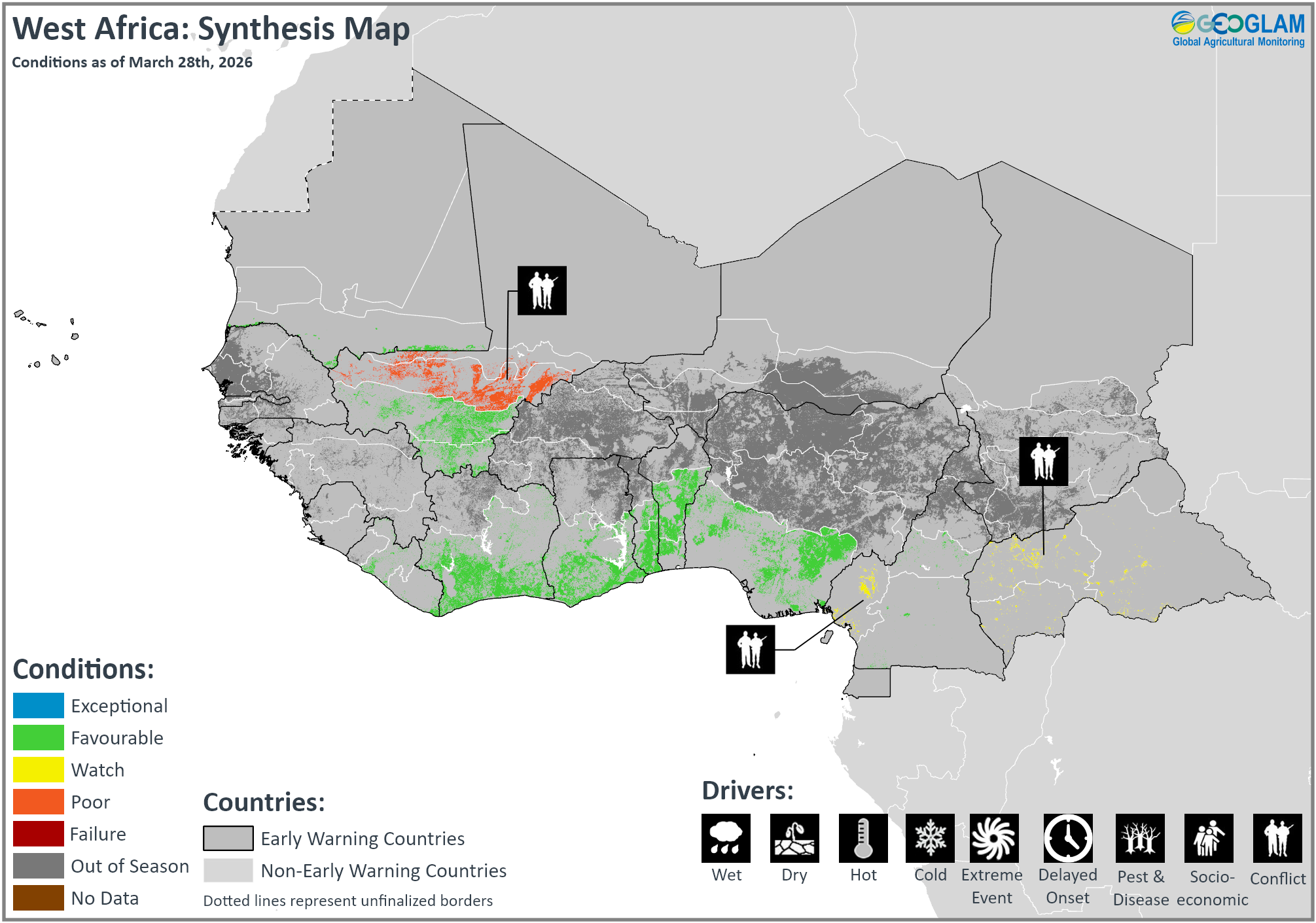
Crop condition map synthesizing crop conditions as of March 28th. Crop conditions over the main growing areas are based on a combination of inputs including remotely sensed data, ground observations, field reports, national, and regional experts. Crops that are in other than favourable conditions are labeled on the map with their driver.
In southern West Africa, planting of main season cereals is now underway in Liberia, Cote d’Ivoire, Ghana, Togo, Benin, Nigeria, Cameroon, and the Central African Republic, and planting of main season rice is underway in southern Nigeria and Adamaoua region in central Cameroon. Elsewhere, land preparation and planting for the 2026 main season continue. Along the Sahel, harvesting of second season rice continues in Mauritania and Mali. Throughout the subregion, vegetation conditions are favourable for the start of the season, though there is concern in areas impacted by persisting conflict, including in central Mali, the Southwest region in Cameroon, and the Central African Republic. Additionally, according to CHIRPS rainfall totals from February 11 to March 10, the southern part of the subregion, from Liberia to the Central African Republic, has received substantial precipitation, ranging from 25 mm to more than 200 mm. The seasonal forecasts of the agro-hydro-climatic characteristics of the main rainy season in the Gulf of Guinea countries indicate a likelihood of average to above-average cumulative rains from March to May, but average to below-average cumulative rains from April to June across most southern areas.
Middle East & North Africa
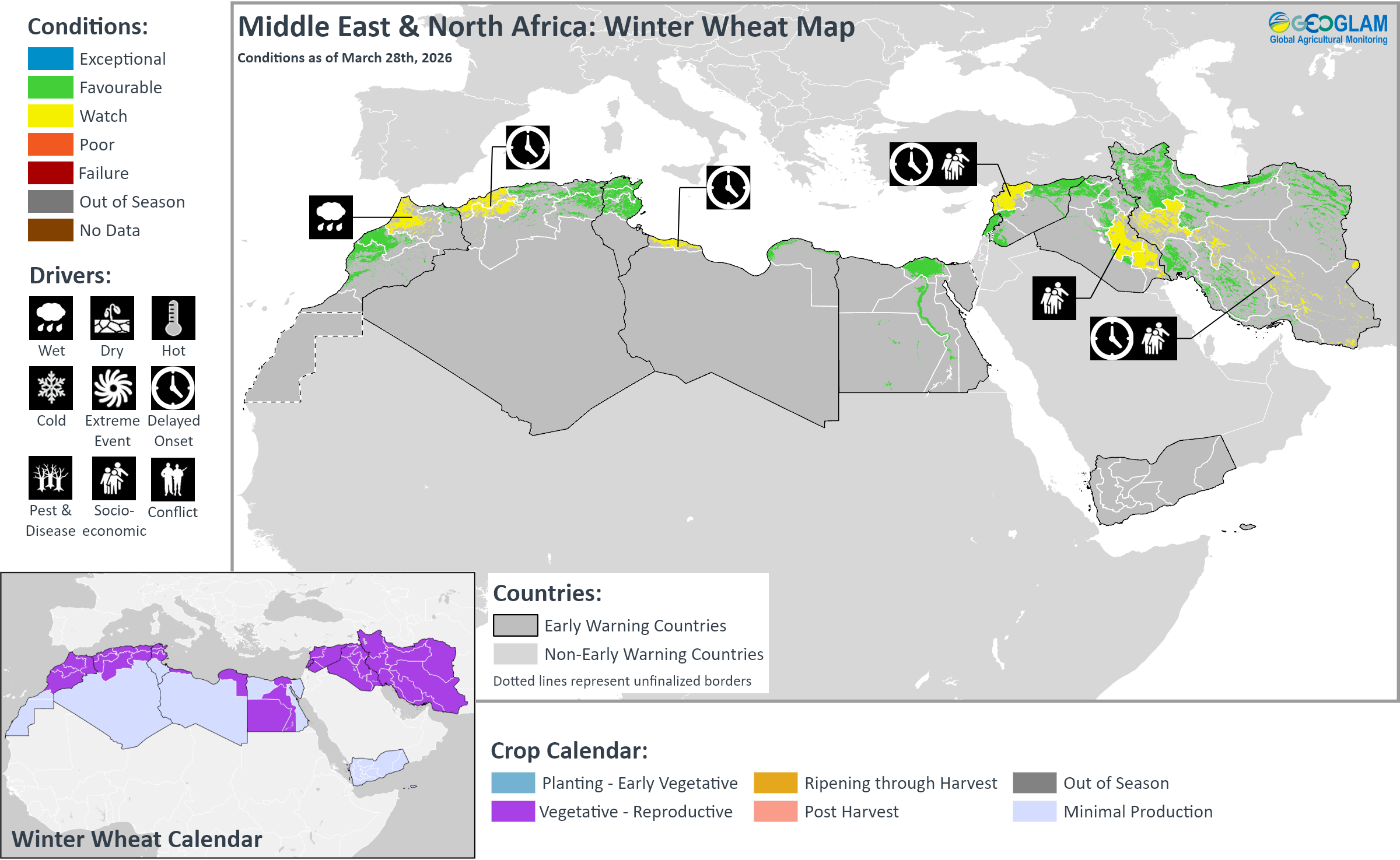
Crop condition map synthesizing Winter Wheat conditions as of March 28th. Crop conditions over the main growing areas are based on a combination of inputs including remotely sensed data, ground observations, field reports, national, and regional experts. Crops that are in other than favourable conditions are labeled on the map with their driver.
Across the Middle East and North Africa, winter wheat continues to develop across Morocco, Algeria, Tunisia, Libya, Egypt, Lebanon, Syria, Iraq, and Iran under mixed conditions. Delayed rains at the beginning of the season in October to mid-November 2025 were followed by precipitation improvements from November 2025 to January and February 2026 that benefitted planted crops. The early season dry conditions negatively impacted planting activities and crop emergence in many areas and continue to cause concern in northwestern Algeria, northwestern Libya, northwestern Syria, and parts of Iran. In parts of southeastern Iraq, crop biomass is below average due to a government decision to limit the area of cultivation using surface water. Conversely, in northwestern Morocco, some areas were negatively affected by flooding in March. Across the Middle East, escalating regional conflict and related supply chain disruptions are driving up fuel and fertilizer prices, increasing the risk of agricultural challenges this season.
In Morocco, delayed rainfall onset at the beginning of the season from October to mid-November 2025 resulted in delayed cereal planting. However, a shift to abundant rains at the end of November and in December 2025 and January 2026 across the country and in February 2026 in the north improved water reservoir levels for irrigation and soil moisture levels, supporting crop establishment and early development. Cumulative rainfall since October is the highest in the last 25 years in the centre and northwest. Rains were near average in March, and crop biomass is well above average in most provinces, including in the eastern regions (Tadla Azilal, Maknes, and Oriental) where cereal growth was initially delayed. Conversely, Tanger Tetouan and Gharb provinces located in the northwest were negatively affected by flooding, and visible water on a large area of arable land resulted in crop damage. In Algeria, rainfall distribution has been uneven since the beginning of the season. In the northwest, rainfall deficits in October and November 2025 delayed planting and constrained crop establishment. Soil moisture conditions have improved since December, resulting in biomass improvement from Tlemcen to Mascara. Conversely, a severe weather system in late January 2026 triggered flash floods in several provinces, including Relizane, Chlef, Tiaret, Tissemsilt, Médéa, and Aïn Defla, resulting in localized damage. Crop biomass remains low in Tiaret, a key producing region, and Tissemlit, suggesting a reduction in the sown area. In the key producing northeastern provinces (from Medea to the Tunisian border), timely and abundant rains supported timely planting and early growth, and winter cereal biomass is average to above average. In Tunisia, the main producing northern regions received dry weather conditions at the beginning of the season between October and December 2025 that delayed initial cereal growth, particularly in the northeast. Conversely, a shift to abundant rains in December 2025 and January 2026 offset initial deficits, and precipitation remained near average in February and March 2026, supporting crop development. Winter cereals are developing under favorable conditions across all producing governorates. Crop biomass is near average in Bizerte and Nabeul, and above average in Beja, Jendouba, Le Kef, Siliana, and Kairouan. In the northeastern governorates of Zaghouan and Ben Arous, biomass has recovered from an initially well below-average start and is now above average. In Libya, early season dryness was followed by a shift to abundant rains in December 2025. However, moisture conditions have remained below average in the western producing regions, particularly around Tripoli where 60 percent of normal rainfall was received from late December. In these areas, biomass is low (from Az Zawia to Misurata), likely due to a reduction in the planted area. Eastern producing areas around Banghazi were affected to a lesser extent, and biomass is generally good, with the exception of Darna. In Egypt, prior to the start of planting in October 2025, the government encouraged an expansion in planted area by setting the wheat procurement price at more than 40 percent above international prices and distributing certified seeds. Official estimates indicate the planted area increased year on year to 1.5 million hectares. Farmers are now preparing for the 2026 harvest, and production is expected to increase due to significant government-provided financial incentives and supportive measures to bolster national food security. Wheat output is currently expected at 9.8 million tonnes, the second largest on record and a 6.5 percent increase compared to the previous year due to an expansion in the seeded area. Average yield is projected to be 6.53 tonnes per hectare and down from 6.92 tonnes per hectare last year. Land preparation is underway for summer-planted rice, and planting will begin in April.
In Lebanon, crop biomass is near average despite variable rainfall outcomes since the start of the season. A new escalation in conflict since March 2 has resulted in a large increase in displacement. While the conflict is likely not directly affecting the main producing area in the centre of the country, there may be related impacts on oil and fertilizer prices and availability this season. In Syria, planted area of winter cereals increased from the previous year, though overall conditions of winter cereals remain mixed. While good rains since January have improved conditions in the northwest (Idleb, Hama, and Aleppo), crop biomass remains below average, likely due to a dry start to the season that resulted in a reduction of the sown area. Conversely, good moisture conditions since the start of the season have resulted in near-average crop biomass in the centre and northeast (Raqqa, Dayr Az Zor, and Hassakeh) and above-average biomass in the south (Dara and As Suweida). Overall harvesting prospects are below average due to the biomass deficit in the northwest. Additionally, high input costs may limit farmers’ access to fertilizer, undermining cereal output. In Iraq, dry weather conditions in October and November 2025 hampered planting operations and delayed the establishment of 2026 cereal crops, mainly wheat and barley. Late rainfall onset improved soil moisture conditions in December 2025, which remained above average from January to March 2026 across the country, benefitting crop development. The rains resulted in favourable cereal conditions in the main producing northern areas (Sulaymaniyah, Ninewa, Dahuk, Erbil, Kirkuk, Salah Al-Din, and Diyala). Conversely, cereal biomass is well below average in the southeast (Babil, Qadissiya, Wassit, Thi-Qar, and Missan) as the government restricted the area irrigated with surface water by 50 percent. Only Najaf shows above-average biomass due to irrigation modernization. In Iran, below-average rainfall at the end of October and particularly in November 2025 was followed by a shift to abundant rains received from December 2025 to early February 2026. The improved rains combined with high temperatures since February have benefitted vegetation growth and helped replenish reservoirs. Dry conditions returned from February to early March across the northwest but were followed by a shift back to good rains in mid-March. Overall biomass is mixed, with below-average biomass in the centre west (Kermanshah, Lorestan, Esfahan, and Ghom), likely due to a dry start to the season that resulted in a reduction of the sown area. Conversely, in Khuzestan, biomass is above average due to irrigation use. Biomass is also average to above average in the north (from West Azerbayejan and Kordestan to Golestan and Khorasan) and centre. Additionally, biomass improved in Fars province located in the southwest. The overall wheat harvest is estimated at around 13 million tons, of which the government plans to procure 10 to 10.5 million tons.
Southern Africa
Crop condition map synthesizing Maize 1 conditions as of March 28th. Crop conditions over the main growing areas are based on a combination of inputs including remotely sensed data, ground observations, field reports, national, and regional experts. Crops that are in other than favourable conditions are labeled on the map with their driver.
Across Southern Africa, main season cereals range from maturation to late vegetative stages, and harvesting is just beginning or will start from April across most countries, including in Angola, Namibia, Botswana, Zimbabwe, Zambia, Malawi, Mozambique, Madagascar, South Africa, Lesotho, and eSwatini. There is concern in parts of central and eastern Madagascar regarding the recent impacts of tropical cyclones, while dry concerns remain present in parts of northwestern Angola and much of Madagascar where October 2025 to early April 2026 cumulative rains are below average (See Regional Outlook Pg. 13). Dry concerns also remain across Zimbabwe due to early season deficits, though recent precipitation improvements in March resulted in some crop recovery. Concern also remains in the conflict-affected areas of Cabo Delgado region in Mozambique and Kivu region in the Democratic Republic of the Congo. Elsewhere, harvesting conditions are favourable despite erratic rainfall received during the second dekad of March in many areas, and crops in eSwatini and Mozambique have recovered from dry spells in February due to improved rains over the last month. Across most areas of the region, seasonal rainfall totals are average to above average (See Regional Outlook Pg. 13). Heavy rainfall and tropical cyclones have affected some areas since mid-December, particularly in Mozambique, as well as in Madagascar which received intense downpours in December 2025 and was affected by cyclones Fytia and Gezani in January and February 2026. South Africa declared a national state of disaster due to heavy flooding in January, and significant flooding was also recently reported in Zambia and Zimbabwe. Despite mixed weather conditions this season, prospects for the 2026 cereal season are generally favourable, and late planted crops are expected to have benefitted from the recent rains, with an above-average overall harvest expected for the subregion for a second consecutive year. Furthermore, land preparation for winter wheat is underway in South Africa, Lesotho, and Zimbabwe, and planting will begin in April.
In Angola, dry concerns remain in west and central producing areas. While some rainfall was received in March in these areas, particularly during the second dekad, temperatures remained high, and poor rainfall performance this season continues to impact ground conditions. There is a limited chance for crop recovery, and production is expected to be average to below average for 2026. In key cereal-producing central provinces, cumulative rains between November 2025 and February 2026 were half the long-term average, though recent rains resulted in some crop improvement. Conversely, conditions remain favourable in the south and east. Rainfall in Cunene province from February 21 to 23 resulted in flooding and infrastructure damage, though growing conditions remain favourable. In Zimbabwe, prior dry conditions in late January through February resulted in severe moisture stress and some crop losses. Good rains received in March across most of the country helped to revive crops but also resulted in crop damage in some areas. Additionally, the prior deficits could still negatively impact cropping outcomes (See Regional Outlook Pg. 13). In Zambia, SADC estimates over 29,300 hectares of crops have been washed away by the recent floods. However, overall growing conditions remain favourable. In Malawi, December 2025 through early March 2026 rainfall totals were near average across the country and will likely support an average harvest during April and May. While localized dry spells along the south resulted in crop wilting and affected about 15 to 20 percent of planted maize, overall growing conditions remain favourable. In Mozambique, weeks of intense rainfall and widespread flooding this season impacted south and central areas, particularly in Gaza province as well as in Maputo and Sofala. SADC estimates 288,000 hectares of farmland and 531,000 livestock have been lost as of early March, compounding food insecurity challenges following the previous season’s El Niño-induced drought. Southern provinces were most affected by heavy rainfall, with cumulative precipitation between November 2025 and January 2026 reaching more than twice the average. While southern areas contribute limited amounts to overall national output, a loss of cash crops is likely to reduce farmers’ income. However, overall growing conditions for staple crops remain favourable, except in conflict affected areas of Cabo Delgado located in the northeast. In Madagascar, dry concerns are impacting most areas, except along the west, and recent cyclone impacts continue to affect crops in parts of the centre and east. In the north, which includes some key paddy-producing regions, cumulative rains between November 2025 and January 2026 were more than 40 percent above the long-term average. Conversely, some southern areas have been affected by delayed and reduced rains since the start of the season, and some east and central areas have received below-average rains since late January. Additionally, above-average temperatures may exacerbate dryness in affected areas (See regional Outlook Pg. 13). The country is still recovering from the impact of two successive tropical cyclones, Cyclone Fytia and Intense Tropical Cyclone Gezani, which struck the country within ten days of each other in late January and early February and caused significant crop losses. While some rain received from late February through early March may support replanting efforts, central and eastern areas received record low rainfall from March 1 to 20 that could inhibit crop germination and establishment. In South Africa, while Mpumalanga region received below-normal rainfall from January, yields are expected to remain near average. Overall maize production for the country is estimated at 16.13 million tons, which is 3.1 percent below last season but above the five-year average. In the Democratic Republic of the Congo, harvesting of main season maize and sorghum finalized in the east, and ongoing conflict is expected to result in yield declines. Harvesting of both main and second season cereals is underway in the centre and southeast, while planting continues in the north and east, and overall conditions remain favourable, except in conflict-affected areas of the east. In Kivu region located in the east, an escalation of conflict since January 2025 has caused widespread displacement and land abandonment, resulting in a reduction in planted area and a disruption in cropping activities.
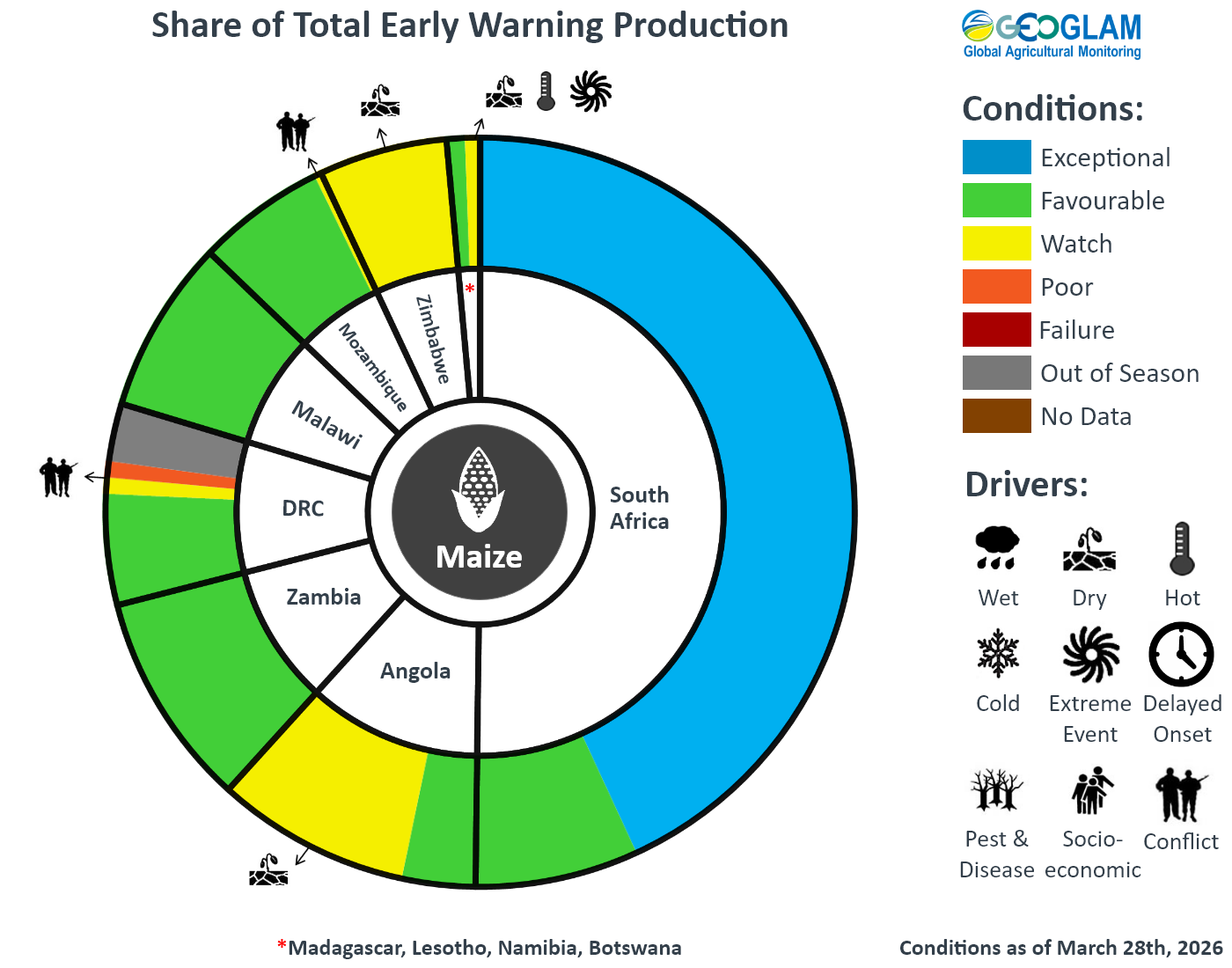
For detailed description of the pie chart please see description box on the bottom of the page.
Regional Outlook: Continuation of below-average rains in eastern and southern Madagascar during April
During recent weeks (Figure 1-left), from February 21st to March 20th, rainfall was substantially below average across eastern and southern Madagascar and western Angola and in localized areas in central Zambia, northeastern Zimbabwe, and western and eastern South Africa.
Below-average rainfall during late January and February had raised concerns about negative impacts to crops in some central and southeastern areas. In many of these areas, above-average rainfall in recent weeks partially improved rainfall conditions. Potential beneficial impacts of the recent rains will likely depend on the timing of local crop development and if key reproductive phases avoided moisture stress. Past two-month rainfall totals, from late January to mid-March, were below average in central-southern Zambia, northeastern and eastern Zimbabwe, central Mozambique, eastern South Africa, and eSwatini (Figure 1 middle-left), despite the above-average rainfall in March.
Locally heavy rains in March caused flooding and fatalities. Days of heavy rains and flooding in mid-March killed 13 people in Malawi. In Mozambique, flooding in March impacted areas in Gaza, Imhanbane, Sofala, Zambezia, Niassa, and Tete provinces, including locations that were flooded during January and February, according to ReliefWeb (March 22nd and March 25th). 37 fatalities were reported. UN OCHA estimates 724,000 people have been affected by flooding in Mozambique since January. Ample rainfall has led to above-average flow in the Zambezi River, and its overflow in some areas has damaged homes and agriculture, such as in Namibia and in eastern downstream areas in central Mozambique.
Very poor seasonal rainfall conditions have occurred in western Angola, and seasonal totals are also below normal in southern Madagascar and portions of northeastern Zimbabwe. Due to prolonged below-average rainfall conditions in central-western and northwestern Angola, October 2025 to early April 2026 rainfall totals are 30 percent of average to less than 75 percent of average. Record-low rainfall amounts are estimated in parts of northwestern Angola. Forecast below-average rainfall during upcoming weeks (Figure 1-right) will continue these issues in northwestern Angola and western and southern Madagascar.

Across most areas of the region, seasonal rainfall totals are above average or average. Kariba Reservoir levels have improved to 20 percent of capacity, as of March 23rd. Above-average rainfall is forecast during upcoming weeks, from late March to mid-April, in South Africa, Angola, northern Zambia, and southern DRC, in some of the flooded zones in central and southern Mozambique, based on next 15-day CHIRPS-GEFS (Figure 1-right) and the 30-day SubC forecasts from March 25th.
Looking to the next main rainfall season, in 2026–2027, there could be greater risks of below-average rainfall and above-average temperatures, associated with long-range forecasts of an El Niño event. As of March 2026, NOAA CPC forecasts high ~80 percent chances that there will be an active El Niño during October to December 2026. The event may develop mid-2026 and will need to be monitored. El Niños can have variable impacts but have often produced droughts in this region. During the last El Niño in 2023–2024, late rainfall onsets and prolonged severe dry and hot conditions mid-season damaged crops and led to drought declarations in Zimbabwe, Zambia, and Malawi.
Figure 1. Percent-of-average rainfall for recent weeks, past two months, and seasonal totals, and a 15-day rainfall anomaly forecast. Left, middle-left and middle-right show CHC Early Estimates. These compare the February 21st to March 20th (left), the January 21st to March 20th (middle-left) and October 1st 2025 to April 5th (middle-right) 2026 precipitation total to the 1981–2025 CHIRPS averages for corresponding accumulation periods. These panels use CHIRPS3 Preliminary for March 1–20, 2026. Right: Forecast next 15-day precipitation anomaly for March 26th to April 9th, 2026. From the CHIRPS3-GEFS forecast, which is a bias-corrected (to CHIRPS v3) version of the NCEP GEFS ensemble mean.
Source: UCSB Climate Hazards Center
Central & South Asia
Crop condition map synthesizing wheat conditions as of March 28th. Crop conditions over the main growing areas are based on a combination of inputs including remotely sensed data, ground observations, field reports, national, and regional experts. Crops that are in other than favourable conditions are labeled on the map with their driver.
In Central & South Asia, winter wheat crops continue to develop across southern Kazakhstan, Kyrgyzstan, Tajikistan, Uzbekistan, Turkmenistan, Afghanistan, and Pakistan, and conditions remain favourable for ongoing crop development, supported by sufficient snow coverage and adequate soil moisture levels. However, warmer than normal temperatures are expected to reduce snow cover and limit soil moisture recharge. Planting of spring wheat is now underway in Kyrgyzstan and Afghanistan under favourable conditions, and planting activities are expected to commence in April across Pakistan, southern Kazakhstan, and Mongolia.
In southern Kazakhstan, winter wheat conditions remain favourable, and yields are forecast to be near average. Planting of the 2026 major spring wheat crop is expected to begin in May in the main northern producing Kostanay and Akmola regions. In Kyrgyzstan, land preparation and planting of spring wheat are just beginning. A total of 1.25 million hectares of spring crops, including wheat, barley, potatoes, and vegetables, are expected to be planted in 2026. The plantings will include 818,000 hectares on irrigated land and 432,000 hectares on rainfed land. The government is encouraging producers to adopt water-saving irrigation technologies, such as drip and sprinkler systems, with financial incentives. In Afghanistan, a dry start to the season in October and November 2025 was followed by favourable, frequent, and geographically well-distributed precipitation from December 2025 to January 2026 that supported winter wheat planting, germination, and early crop establishment. Early season soil moisture deficits and reduced irrigation water availability resulted in a below-average planted area with winter wheat. Cumulative precipitation from October 2025 through February 2026 was generally below average, with some west and southern areas receiving average to above-average amounts. As a result, the overall planted area of winter wheat is below average. Crops are now in the flowering to grain filling stage, and despite variable precipitation outcomes this season, generally adequate timing and distribution have supported favourable growing conditions for winter wheat. However, above-average temperatures are increasing the risk of yellow rust in some areas. Spring wheat planting is just beginning under favourable conditions. Planted area for spring wheat is expected to be near average, supported by favourable February to March precipitation and limited off-farm employment opportunities. While improved seed availability remains low, farmers are relying on local varieties and cultivating where possible. However, currently below-average snow depth and snow water equivalent levels across all major basins could reduce spring and summer runoff availability, limiting surface water for irrigated wheat and second season crops. The situation may increase groundwater use, though farmers report that extraction is largely concentrated on cash crops, orchards, and vegetables, as increased demand is straining groundwater resources and raising pumping costs. Conversely, recent reports indicate that heavy precipitation in late March has resulted in flooding across 25 provinces. Water in some dams has increased due to the heavy rains. In Pakistan, a sufficient supply of irrigation water has resulted in favourable vegetation conditions in the main wheat growing areas. Additionally, recent rains have mitigated concerns regarding prior dry conditions in the northern rainfed Barani areas. This year, the total area under wheat declined from 10.27 million to 9.1 million hectares, due to a combination of limited rains in some areas and a delayed government announcement of wholesale wheat prices, which led many farmers to postpone planting. Overall production is estimated between 28 and 29 million tonnes, representing a decline of 2 to 3 million tonnes from last year. Harvesting activities will be completed by late May, and yields are generally expected to be favourable. Additionally, heavy rainfall and storms since late March have resulted in heavy rains and flooding across some areas, mainly in Khyber Pakhtunkhwa (KP) province.
Southeast Asia
Crop condition map synthesizing rice conditions as of March 28th. Crop conditions over the main growing areas are based on a combination of inputs including remotely sensed data, ground observations, field reports, national, and regional experts. Crops that are in other than favourable conditions are labeled on the map with their driver.
In southern Southeast Asia, the total planted area of wet-season rice is close to the last season. Rice crops in the vegetative to early generative stages are growing under favourable conditions due to adequate irrigation water availability, and harvesting is progressing smoothly. Additionally, seeding of wet-season maize is mostly complete, and growing conditions are generally favourable. The harvested maize yields are expected to be favourable, supported by sufficient irrigation water and sunlight during the crop growth period. Furthermore, planting of dry-season rice is now underway in Malaysia and Brunei.
In northern Southeast Asia, planting of dry-season rice is mostly complete, and the total planted area is expected to slightly decrease compared to the last season. Dry-season rice is mainly in the growing to early harvesting stage, and early harvesting conditions are generally favourable due to adequate weather conditions and a consistent water supply, except in Cambodia where ongoing conflict may constrain final yield outcomes. Additionally, the final sown area of dry-season maize is expected to increase compared to last year due to favourable maize prices. Dry-season maize is mainly in the vegetative to harvesting stage, and yields are generally favourable. However, concern remains in northern Viet Nam due to land preparation and planting delays.
Elsewhere in Southeast Asia, including Sri Lanka, Nepal, and Bangladesh, crops remain under mixed conditions. Harvesting finalized in Sri Lanka, and combined impacts of periods of flooding as well as the passage of Cyclone Ditwah are expected to result in production declines, though the full extent is to be determined. In Nepal, drier than normal conditions continue to impact maize and wheat crops in western producing areas. Elsewhere in Nepal and throughout Bangladesh, agro-climatic conditions remain favourable. However, recent fuel restrictions and fertilizer import disruptions may negatively impact future agricultural activities in Bangladesh.
In Indonesia, March is expected to be the last month of wet-season rice planting. The cumulative planted area has reached 6.5 million hectares, which is slightly higher than the previous wet season, and the planted area continues to increase due to heavy rainfall received from late February to mid-March. Rice crops that are now in the vegetative to early generative stages are growing under favourable conditions due to adequate irrigation water availability. March is also the third month of wet-season rice harvesting. The total harvested area is currently 3.22 million hectares with a favourable yield as crops received sufficient water and sunlight during the growing period. Additionally, March is the last month of wet-season maize planting, with a total planted area of 1.5 million hectares. Growing conditions are generally favourable with adequate irrigation water availability. March is also the third month of the wet-season maize harvest, with a total harvested area of 0.9 million hectares. Overall maize yields are expected to be favourable, supported by sufficient water and sunlight during the growing period. In Malaysia, harvesting of wet-season rice is underway, and about 71 percent of the total planted area has been harvested. Overall conditions remain favourable. Additionally, wet-season maize crops continue to develop across major producing regions. Most maize fields are now entering the reproductive stage, and generally favourable crop conditions are supported by adequate soil moisture. Overall wet-season maize prospects remain stable as crops advance towards the later growth stages. For dry-season rice, planting has been observed in Central and Northern Malaysia, with 22 percent of the granary areas already planted. Overall weather conditions and irrigation water supply remain conducive for ongoing cultivation. In Brunei, harvesting of wet-season rice is 60 percent complete in irrigated areas, while rainfed areas began harvesting in March. Despite high precipitation rates, no major growth damage has been reported, and the outlook for the wet season remains favourable. Land preparation and seeding of dry-season rice is now underway.
Crop condition map synthesizing maize conditions as of March 28th. Crop conditions over the main growing areas are based on a combination of inputs including remotely sensed data, ground observations, field reports, national, and regional experts. Conditions that are other than favourable are labeled on the map with their driver.
In the Philippines, dry-season rice planted from November to December 2025 is in the maturing to harvesting stage. In February 2026, weather systems, including a tropical storm and low-pressure areas, brought continuous rainfall across the Southern Luzon and Visayas regions. However, no significant damage has been reported, and growing conditions remain favourable for dry-season rice due to conducive weather in most rice-producing regions. Additionally, dry-season maize planted from November to December 2025 is in the maturing to harvesting stage. Growing conditions for dry-season maize are generally favourable due to adequate weather conditions, though yield may decline slightly compared to last year due to frequent rainfall and pest presence during the reproductive stage. In Thailand, dry-season rice is in the grain filling and harvesting stages. Both the cultivated area and total production are expected to decrease as farmers are shifting away from second off-season rice crop production to more water-efficient or higher-value crops. However, rice yields are expected to improve, supported by favourable weather conditions. Additionally, planted area for dry-season maize is expected to increase compared to last year, mainly due to favourable prices. Maize crops are now in the harvesting stage, with 40 percent of the total area already harvested, and peak harvesting is likely to occur in March and April. Both maize production and yield are expected to increase, supported by adequate irrigation availability and the use of high-quality seeds. In northern Viet Nam, the sown area of dry-season (winter-spring) rice is estimated at 0.85 million hectares, which is slightly lower than in the same period last year due to adjustments in the cropping calendar to avoid cold spells. Rice crops are currently in the sowing and early vegetative stages, and conditions remain generally favourable, supported by improved irrigation preparation. Additionally, sowing of dry-season maize continued for the third month along the north. The total sown area is estimated at 152.3 thousand hectares, which is 5 percent lower than last year as unfavourable weather conditions delayed prior harvesting of the winter crop and negatively affected the timing of land preparation and sowing for the spring crop. In the south, dry-season (winter-spring) rice is in the harvesting stage. Approximately 0.3 million hectares have been harvested out of a total of 1.9 million hectares planted, and yield prospects remain favourable. Additionally, sowing of dry-season maize is underway with a current area of 47.3 thousand hectares. Rainfall has been sufficient, and conditions are favourable for crop germination. In Laos, planting of dry-season rice is now complete. The planted area reached over 98 thousand hectares, representing 100 percent of the national production plan and a slight increase compared to last year due to sufficient irrigation water and heavy rainfall received in late February. The conditions also supported rice crop growth during the critical young panicle forming to grain filling stages, and the initial yield is estimated at a near-average level of 4.5 tons per hectare. Additionally, the planted area for dry-season maize reached 9.7 thousand hectares, which is more than double the national plan of 4.5 thousand hectares. Maize crops are in the reproductive stage, and growing conditions are favourable due to adequate soil moisture following late February rains. However, localized pest presence and uneven rainfall distribution may negatively impact overall yield performance. In Myanmar, planted area of dry-season rice has reached 950 thousand hectares, accounting for 83 percent of the national plan of 1.13 million hectares. Planting progress is similar to last year, and planting work is expected to continue through April due to the availability of irrigation water and conducive weather. Overall growing conditions are favourable, and crops are mostly at the panicle forming stage. Harvesting of early planted rice has begun, mainly in the delta region. About 33 thousand hectares of dry-season rice have been harvested with a yield of 3.93 tons per hectare, which is similar to last year. Additionally, planting of dry-season maize is nearing completion and has reached 88.6 percent of the national target. Slightly above-normal precipitation and soil moisture continue to support healthy crop development. Most fields are in the reproductive stage with a favourable yield expected. Harvesting of earlier planted maize crops has reached 36.2 percent of the planted area, with a current yield of 3.94 tons per hectare. In Cambodia, planting of dry-season rice has reached 831 thousand hectares, which is 8 percent less than the previous year. Harvesting of dry-season rice is also underway, reaching 45 percent of the planted area with an expected yield of 4.7 tons per hectare, which is slightly higher than last year due to favourable weather. However, ongoing conflict may constrain final rice yield outcomes. Additionally, the final planted area of dry-season maize reached 93 percent of the national plan, which is close to the previous year. Harvested area for maize reached 35 percent of total planted area with an average yield of 6.0 tons per hectare, which is slightly higher than last year.
In Sri Lanka, harvesting of Maha season maize (90 percent of annual maize output) and Maha season rice (60 percent of annual rice output) finalized in March. Combined impacts of heavy rains and flooding in October 2025, the impacts of Cyclone Ditwah in late November 2025, and additional flooding in February 2026 that affected crops prior to harvest, particularly in eastern parts of the country, are expected to result in below-average production. However, the extent of the decline has yet to be quantified, and end of season conditions will be reported next month. Land preparation is underway for Yala season maize (10 percent of annual maize output) and Yala season rice (40 percent of annual rice output), and planting will begin in April. In Nepal, wheat harvesting is just beginning, while planting of main season maize continues, and concern remains in western areas experiencing drier than normal conditions. Planting of second season rice is just beginning under favourable conditions. In Bangladesh, harvesting of winter (Rabi) season maize and Rabi season wheat is just beginning, while Boro season rice (55 percent of annual rice output) continues to develop for harvest from April. Additionally, planting of summer (Kharif) season maize (15 percent of annual maize production) and Aus season rice (10 percent of annual rice production) is just beginning. Overall agro-climatic conditions are favourable for the various cropping activities. However, the government's restricted fuel supply in response to the ongoing conflict in the Middle East is now impacting irrigation activities for paddy and other crops, raising risks of disruption for Boro season cultivation. Farmers are unable to obtain the amounts of diesel they need for irrigation as pumps are only selling limited quantities. Ongoing trade disruptions in the Strait of Hormuz risk constraining fertilizer imports and inflating input costs, while associated gas shortages could further suppress domestic fertilizer production. In the Democratic People’s Republic of Korea, land preparation is underway for main season maize, and planting will begin in April.
For detailed description of the pie chart please see description box on the bottom of the page.
Central America & Caribbean
Crop condition map synthesizing Beans 3 (Apante season) conditions as of March 28th. Crop conditions over the main growing areas are based on a combination of inputs including remotely sensed data, ground observations, field reports, national, and regional experts. Conditions that are other than favourable are labeled on the map with their driver.
In Central America, land preparation for the Primera season is underway, and planting will commence in April. In Honduras and Nicaragua, harvesting of Apante season bean crops finalized in March under favourable conditions. In northern Honduras, harvesting of second season rice is nearing completion under favourable conditions and will finalize in April. Above-average rains are forecast during late March to April, signalling a favourable start to Primera season planting. However, longer range forecasts indicate below-average rains from May to July across Guatemala, El Salvador, western and central Honduras, western Nicaragua, and Haiti, coinciding with the expected onset of El Niño in the coming months (See Climate Influences Pg. 3 and Regional Outlook Pg. 19).
In Haiti, harvesting of Hiver season beans finalized in March under favourable conditions. Harvesting of second season rice also finalized in March, and end of season conditions will be reported next month due to uncertainty regarding the impacts of overly wet conditions on final yields. Additionally, planting for Printemps season cereals and main season rice is underway. While sufficient rains have benefitted irrigation water availability and soil moisture levels (See Regional Outlook Pg. 19), there is some concern regarding the potential impact of recent precipitation on soil conditions. However, field reports indicate favourable conditions for the start of the season. In Cuba, harvesting of second season maize is just beginning while second season rice crops (1/3 of annual rice production) continue to develop, and there is ongoing concern regarding prior drier than normal conditions in January and February as well as oil shortages which have resulted in power and water supply disruptions. However, recent rainfall improvements over the last month may have resulted in some crop recovery, and above-average rains are expected to continue through April (See Regional Outlook Pg. 19).
Regional Outlook: A rainy forecast for upcoming weeks, and increased risks of below-average May to September 2026 rainfall
Primera season rainfall is forecast to begin well, with above-average rainfall during late March to early April. As of March 25th, above-average rainfall and cooler-than-average temperatures are forecast during that period by several forecast systems including ECMWF, GEFS, and most SubC models. Figure 1-left shows the 30-day rainfall outlook from the SubC multi-model ensemble. For rainfall during the latter half of April, the longer-range SubC model and ECMWF forecasts do not provide a clear outlook due to model disagreement. The ECMWF (not shown) indicates drier-than average conditions in northern Guatemala and the Caribbean towards the end of April and early May. In Haiti, sufficient rainfall has benefitted irrigation systems and soil moisture in cultivated areas.
During May to July (MJJ) 2026, and beyond, there will be elevated risks of below-normal rainfall in Central America and the Caribbean, according to C3S (Figure 1-middle), WMO, and NMME climate model forecasts from early March. NOAA PSL’s C3S ensemble forecast predicts 40 to 60 percent chances of below-normal MJJ 2026 rainfall in Guatemala, El Salvador, western and central Honduras, western Nicaragua, and Haiti. Models also predict elevated chances of hotter-than-normal temperatures. These outlooks are consistent with the forecast development of an El Niño event. The NOAA CPC March 2026 official ENSO outlook predicts 62 to 72 percent chances of El Niño criteria being met during June to September 2026 and ~ 80 percent chances through the end of 2026.
El Niños tend to have a regional drying influence, though events can have variable impacts. During nine past years when El Niño was active during JJAS, historical rainfall data show that JJAS precipitation totals were below-normal more often in Guatemala, El Salvador, western and central Honduras, western Nicaragua, and Haiti, while drying influences were less common in eastern areas of Honduras and Nicaragua. If El Niño conditions develop, elevated chances of drier-than-normal conditions in the region would continue during the Segunda 2026 season.
Figure 1. Rainfall probability forecasts for late March to mid-April 2026 and for May to July 2026, and historical June to September rainfall outcomes during El Niño events. Left: SubC multi-model 30-day rainfall tercile probability forecast for March 26th to April 24th, 2026. Colors show the dominant category forecast by four Subseasonal Consortium models, using terciles identified from 1999-2016 hindcasts. From UCSB CHC SubC. SubC data acquired from the IRI Data Library. Middle: Forecast probability of above-normal and below-normal May to July 2026 rainfall, based on five Copernicus Climate Change Service (C3S) models, using terciles identified from 1993-2016 hindcasts, and March initial conditions. From NOAA PSL Monthly to Seasonal C3S Forecasts. Right: The frequency of below-normal June-to-September rainfall during years with concurrent El Niño conditions (1982, 1987, 1991, 1994, 1997, 2002, 2004, 2015, 2023), relative to 1991-2020 CHIRPS v3 terciles. In areas with orange to dark red colors, below-normal rains occurred in four to nine years (40 to 100%). From UCSB CHC.
Source: UCSB Climate Hazards Center
Pie Chart Description: Each slice represents a country’s share of total regional production. The proportion within each national slice is colored according to the crop conditions within a specific growing area; grey indicates that the respective area is out of season. Sections within each slide are weighted by the sub-national production statistics (5-year average) of the respective country. The section within each national slice also accounts for multiple cropping seasons (i.e. spring and winter wheat) and are a result of combining totals from multiple seasons to represent the total yearly national production. When conditions are other than favourable icons are added that provide information on the key climatic drivers affecting conditions.
Information on crop conditions in the main production and export countries can be found in the Crop Monitor for AMIS, published April 2nd, 2026.
Sources and Disclaimers: The Crop Monitor assessment is conducted by GEOGLAM with inputs from the following partners FEWS NET, JRC, WFP, ARC, AFSIS, MESA, ICPAC, FAO GIEWS, Applied Geosolutions and UMD. The findings and conclusions in this joint multi-agency report are consensual statements from the GEOGLAM experts, and do not necessarily reflect those of the individual agencies represented by these experts.