
Global Crop Monitor
Report Information
No. 47: Published September 3rd 2026
Conditions as of August 28th
To access all reports, please visit the Archive.
Please visit the Referencing Guidelines page for information on how to cite the Crop Monitor reports and products.
Synthesized from the Crop Monitor for AMIS, the Crop Monitor for Early Warning, and direct submissions from individual countries.
Crop conditions over the main growing areas are based on inputs, including remotely sensed data, ground observations, field reports, and national and regional experts. Regions in conditions other than favourable are labelled on the map with a symbol representing the crop(s) affected.
Global Crop Overview
Global crop conditions at the end of August remain generally positive for wheat, rice, and soybeans, while conditions are mixed for maize. Wheat conditions are generally favourable, albeit with a wide variety of conditions, from exceptional to poor across the Northern Hemisphere. Conditions are mostly favourable in the Southern Hemisphere. Maize conditions are mixed across Europe, southern India, East Africa, Southeast Asia, and the US. Rice conditions are generally favourable; however, dryness remains a concern in parts of South and Southeast Asia. Soybean conditions are mostly favourable except in Europe and parts of the US. The remaining crops are discussed in the CM4EW publication.
Global Climate Influences Overview
El Niño conditions are present. This will most likely be a very strong event (~ 90% chance from September 2026 to January 2027, according to the August 2026 NOAA ENSO outlook), ranking as one of the strongest since 1950. El Niño conditions are forecast through May 2027 (82% chance).
During late August through early September 2026, abnormally hot temperatures are forecast in active crop development areas of the central and southeastern United States, Mexico, Central America, the Caribbean, northeastern Paraguay, southern Europe, West Africa, the Sahel region, and East Africa, Yemen, southern and northern India, Pakistan, Central Asia, northeastern China, southern Vietnam, and the southern Philippines.
For further details on the Global Climate Influences and Regional Climate Outlooks section.
WHEAT
Wheat crop conditions over the main growing areas are based upon a combination of national and regional crop analyst inputs, along with earth observation data. Conditions are based upon information as of August 28th.
In North America, the US winter wheat harvest is wrapping up. Spring wheat harvesting is progressing with above-average yields. In Canada, winter wheat harvesting is progressing, and the spring wheat harvest is just beginning, with above-average yields expected in Alberta. In Mexico, spring wheat conditions are favourable. In Europe, EU harvesting is finishing, with above-average yields in Bulgaria and Romania offset by below-average yields in parts of western and central Europe. In the United Kingdom, harvesting is wrapping up with poor yields due to a hot and dry spring. In Türkiye, the winter wheat harvest is wrapping up with exceptional yields. In Ukraine, harvesting is finishing with exceptional yields. In the Russian Federation, winter wheat harvesting is concluding with above-average yields in the south. Spring wheat harvesting is beginning under favourable conditions, with a smaller total sown area than last year. In Central Asia, winter wheat harvesting has finalized across southern Kazakhstan, Kyrgyzstan, Tajikistan, Uzbekistan, and Turkmenistan with good yields. In Afghanistan, wheat harvesting continues in parts of the central and northeastern regions. Spring wheat harvesting is just beginning in Kazakhstan, Kyrgyzstan, and Tajikistan under favourable conditions. In East Asia, spring wheat in China is being harvested under favourable conditions. In Mongolia, spring wheat is under favourable conditions. In Sub-Saharan Africa, conditions in South Africa are favourable over the interior, following widespread above-normal late-summer and autumn rain. However, dry weather over the Western Cape during July and August has negatively affected the crop. Winter wheat is under favourable conditions in Lesotho, Zambia, and Zimbabwe. A bumper crop is expected in Zambia and Zimbabwe due to good antecedent soil moisture and adequate reservoir levels, which have benefitted irrigation water availability. In Oceania, conditions in Australia are exceptional in South Australia and Victoria; however, dryness has reduced prospects in Queensland. In South America, conditions in Argentina are favourable, with earlier areas of excess moisture receding. In Brazil, conditions are favourable despite the excessive rainfall in some areas. There is a decrease in total sown area compared to last year. In Uruguay, conditions are favourable with good crop development and ample precipitation. In Chile, conditions are poor due to heavy rainfall and waterlogged soils.
For detailed description of the pie chart, please see box on the bottom of the page.
MAIZE
Maize crop conditions over the main growing areas are based upon a combination of national and regional crop analyst inputs, along with earth observation data. Conditions are based upon information as of August 28th.
In South America, harvesting in Brazil of the summer-planted crop (larger season) is progressing, with yields above average in the North and Center-West regions. In Central America & the Caribbean, conditions in Mexico are favourable for the spring-summer crop (larger season). Harvesting of Primera season crops is underway in Guatemala, El Salvador, Honduras, and Nicaragua. Conditions are poor in Honduras and Nicaragua, and concern remains in Guatemala and El Salvador due to extended dry spells and high temperatures this season. In Cuba, sowing of the main-season crop continues. In Haiti, harvesting of the Printemps season is wrapping up as the sowing of the Été season crops continues. In North America, the US saw a mix of hot, dry weather in the western Corn Belt and heavy rainfall in the eastern Corn Belt, threatening yields. In Canada, conditions are favourable, with good development. In Europe, persistent heat and drought in the EU have substantially worsened crop conditions across western and most of central Europe. In Ukraine, hot, dry weather has caused damage and the premature drying of crops across the country. In the Russian Federation, conditions range from favourable to exceptional. In South Asia, sowing in India of the Kharif crop (larger season) is wrapping up, with a reduction in total sown area compared to last year, most noticeably in Karnataka state. In Pakistan, heat and moisture stress is negatively impacting crops in Punjab and Balochistan. In Sri Lanka, harvesting of Yala season maize is beginning. In Nepal, main-season maize is being harvested. In East Asia, harvesting in China is beginning for the spring-maize crop (larger season), while the summer-maize crop (smaller season) may have been negatively affected by earlier high temperatures. In the DPRK, maize harvesting is underway. In Southeast Asia, dry-season crop harvesting in Indonesia continues with good yields, though total sown area is slightly lower than last year. In Malaysia, dry-season crops are under favourable conditions. The wet-season crop is favourable in Cambodia, Lao PDR, Myanmar, most of the Philippines, and Viet Nam. In Thailand, wet-season maize is being negatively affected by dry weather. In East Africa, harvesting of main/Meher season crops is wrapping up in the south, while crops continue to develop in the north. Prolonged rainfall deficits since the start of the season and high temperatures are expected to negatively impact yields in Sudan, South Sudan, Ethiopia, Somalia, Kenya, and northeastern Uganda. In West Africa, harvesting is ongoing in Sierra Leone, Liberia, Côte d’Ivoire, Ghana, Togo, Benin, Nigeria, and Cameroon, and the sowing of second-season crops is underway in Côte d’Ivoire, southern Ghana, southern Togo, southern Benin, Nigeria, and northern Cameroon.
For detailed description of the pie chart, please see box on the bottom of the page.
RICE
Rice crop conditions over the main growing areas are based upon a combination of national and regional crop analyst inputs, along with earth observation data. Conditions are based upon information as of August 28th.
In East Asia, conditions in China are favourable for both single-season rice (largest season) and late double-crop rice (medium season). In Japan, conditions are generally favourable. In the Republic of Korea, conditions are favourable. In the DPRK, conditions are favourable. In Central & South Asia, sowing in India for the Kharif crop is wrapping up in the northern and central states and is in the final stages in the eastern and southern states, with a marginal reduction in total sown area compared to last year. In Bangladesh, harvesting of the Aus crop (smallest season) is wrapping up with some damage from earlier floods. Transplanting continues for the Aman crop (medium season). In Pakistan, heat and moisture stress is of concern in Punjab and Balochistan for Kharif season rice. In Sri Lanka, Yala season rice harvest is beginning. In Nepal, conditions are favourable for main-season rice. In Southeast Asia, sowing of dry-season rice in Indonesia is finishing as harvesting of earlier-sown crops continues. In Malaysia, harvesting of dry-season rice is progressing as sowing begins for wet-season rice. In Brunei, harvesting of dry-season rice is continuing. In Viet Nam, summer-autumn rice (wet-season rice) in the north is developing, while the main-season rice (seasonal rice) crop is being sown. In the south, summer-autumn rice (wet-season rice) is being harvested as autumn-winter rice and seasonal rice develop. In Thailand, wet-season rice is experiencing mixed conditions due to drought and an outbreak of rice blast disease that has affected rice growth and development. In the Philippines, heavy rains and strong winds from an enhanced southwest monsoon and tropical cyclones in early August have damaged wet-season rice crops. In Myanmar, sowing of wet-season rice is progressing under favourable conditions. In Cambodia, wet-season rice is suffering from drought. In Laos, wet-season rice sowing is under favourable conditions. In the Americas, conditions are favourable in the US. In Mexico, sowing continues for the Spring-Summer crop with an expected increase in total sown area compared to last year. In Cuba, sowing of main-season rice is continuing, albeit with persistent energy shortages that are hampering sowing. In Haiti, the harvest of the main-season rice is finishing. In MENA, conditions are favourable across Egypt, Iraq, and Iran. In Sub-Saharan Africa, conditions are favourable in West Africa; however, conflict remains a negative factor in the Sahel areas of Mali and Nigeria.
For detailed description of the pie chart, please see box on the bottom of the page.
SOYBEAN
Soybean crop conditions over the main growing areas are based upon a combination of national and regional crop analyst inputs, along with earth observation data. Conditions are based upon information as of August 28th.
In North America, conditions in the US remain generally favourable, though hot, dry weather is negatively affecting crops in the northwestern Corn Belt. In Canada, conditions are favourable, with overall yields expected to be near average. In Mexico, conditions are favourable, with a large increase in sown area compared to last year due to supportive rainfall. In Europe, conditions are poor in the EU, with high temperatures and dry weather negatively impacting crops. In Ukraine, conditions have deteriorated due to recent heat waves and below-average precipitation, damaging crops and causing premature drying across most of the country. In the Russian Federation, conditions are favourable to exceptional due to good rains throughout the season in the south. In Asia, conditions are favourable in China, with crops in the pod-filling stage. In India, sowing is wrapping up under generally favourable conditions, with only a slight decrease in total sown area compared to last year due to early-season dry spells. In Africa, conditions are mostly favourable in Nigeria.
For detailed description of the pie chart, please see box on the bottom of the page.
Pie Chart Description: Each slice represents a country's share of total Global production (5-year average). Main producing countries (representing 90-95 percent of production) are shown individually, with the remaining 5-10 percent grouped into the “Smaller Producing Countries” category. The proportion within each national slice is coloured according to the crop conditions within a specific growing area; grey indicates that the respective area is out of season. Sections within each slide are weighted by the sub-national production statistics (5-year average) of the respective country. The section within each national slice also accounts for multiple cropping seasons (e.g., spring and winter wheat). When conditions are other than ‘favourable’, icons are added that provide information on the key climatic drivers affecting conditions.
Global Climate Influences
El Niño conditions are present. This will most likely be a very strong event (~ 90% chance from September 2026 to January 2027, according to the August 2026 NOAA ENSO outlook), ranking as one of the strongest since 1950. El Niño conditions are forecast through May 2027 (82% chance).
El Niño events tend to enhance rainfall in Central Asia, southern North America, south-eastern South America, southern Europe, eastern and southern East Africa, and southern and eastern China. Drier-than-average conditions tend to occur in Central America, the Caribbean, northern South America, parts of western and northern East Africa, the Sahel region, Southern Africa, India, Northern China, the Maritime Continent, and Australia.
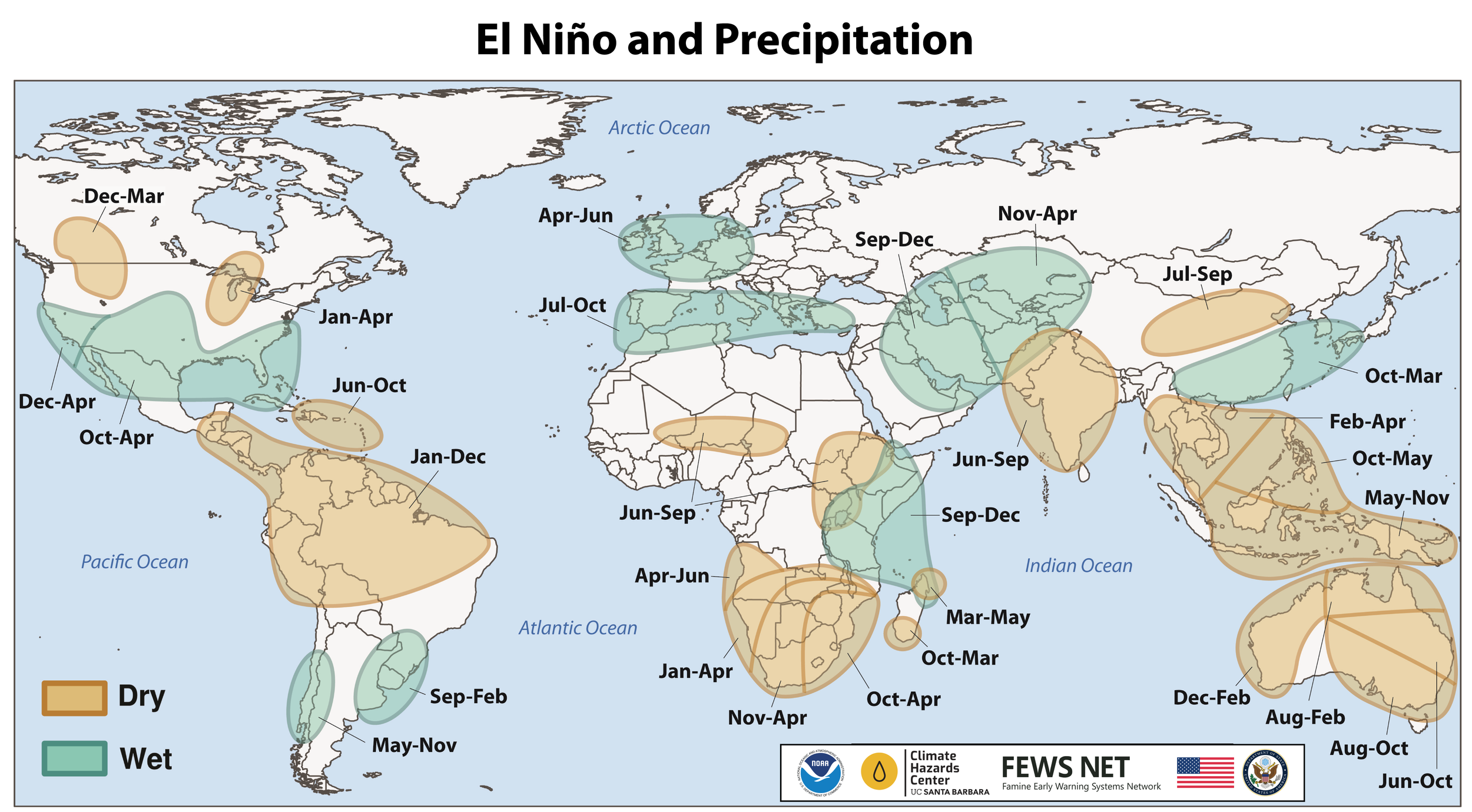
Location and timing of likely above- and below-average precipitation related to El Niño events. Based upon observed precipitation during 22 El Niño events since 1950, wet and dry correspond to a statistically significant increase in the frequency of precipitation in the upper and lower thirds of historical values, respectively. Statistical significance at the 95% level is based on the resampling of precipitation during neutral El Niño-Southern Oscillation conditions. Source: FEWS NET & NOAA & CHC
Positive Indian Ocean Dipole (IOD) conditions are forecast during September to December 2026, with a strong event possible. A positive IOD tends to enhance the drying influence of El Niño in Australia and the Maritime Continent and substantially increase the chances of a wet and intense East Africa short rains season.
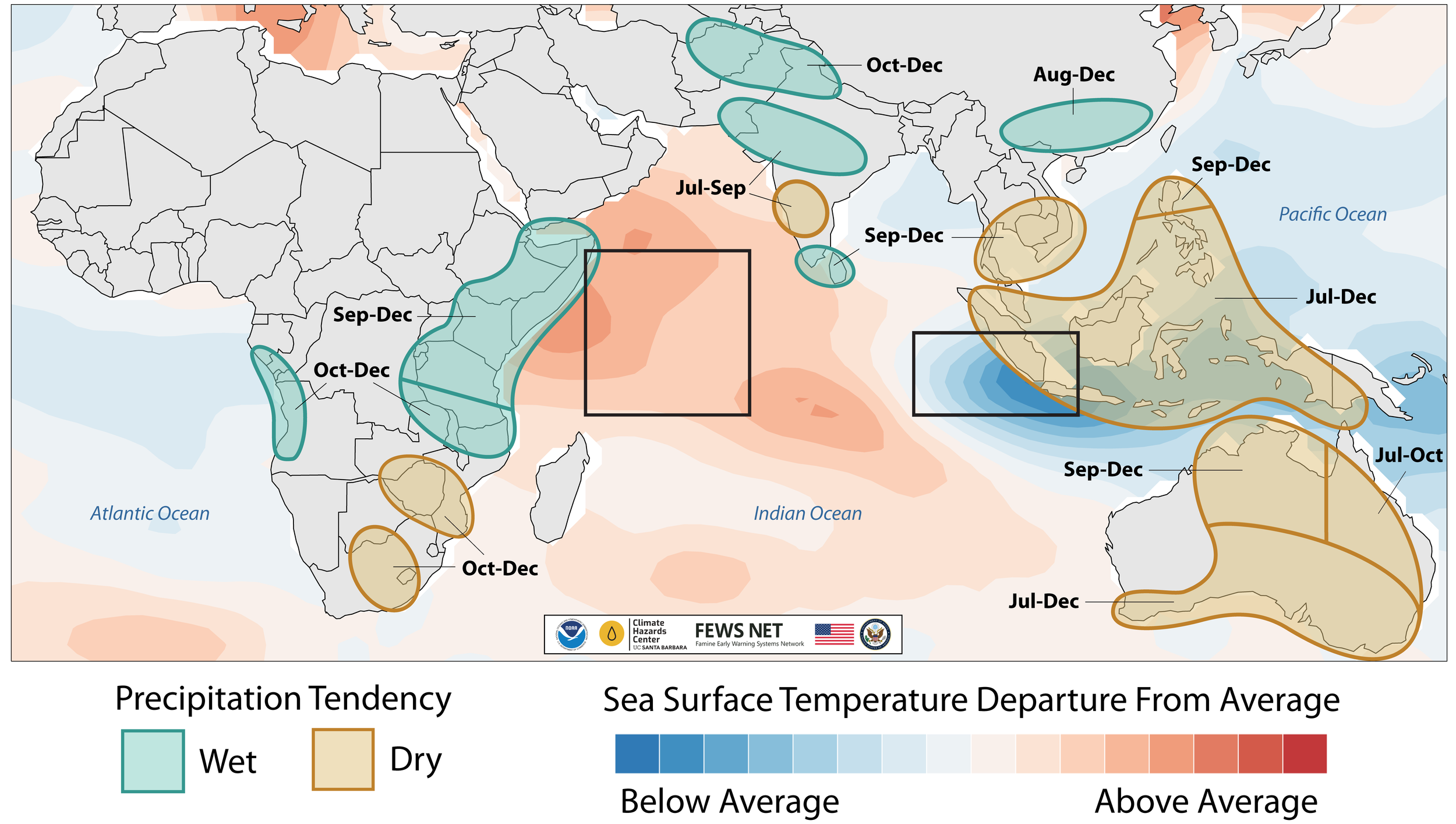
The timing of wet and dry conditions based on Climate Research Unit, CHIRPS, and Global Precipitation Climatology Centre precipitation (green and brown polygons), and sea surface temperature departures from average during July September (blue and red shading), related to the IOD. The regions used to define the Dipole Mode Index are outlined in black.
During late August through early September 2026, abnormally hot temperatures are forecast in active crop development areas of the central and southeastern United States, Mexico, Central America, the Caribbean, northeastern Paraguay, southern Europe, West Africa, the Sahel region, and East Africa, Yemen, southern and northern India, Pakistan, Central Asia, northeastern China, southern Vietnam, and the southern Philippines.
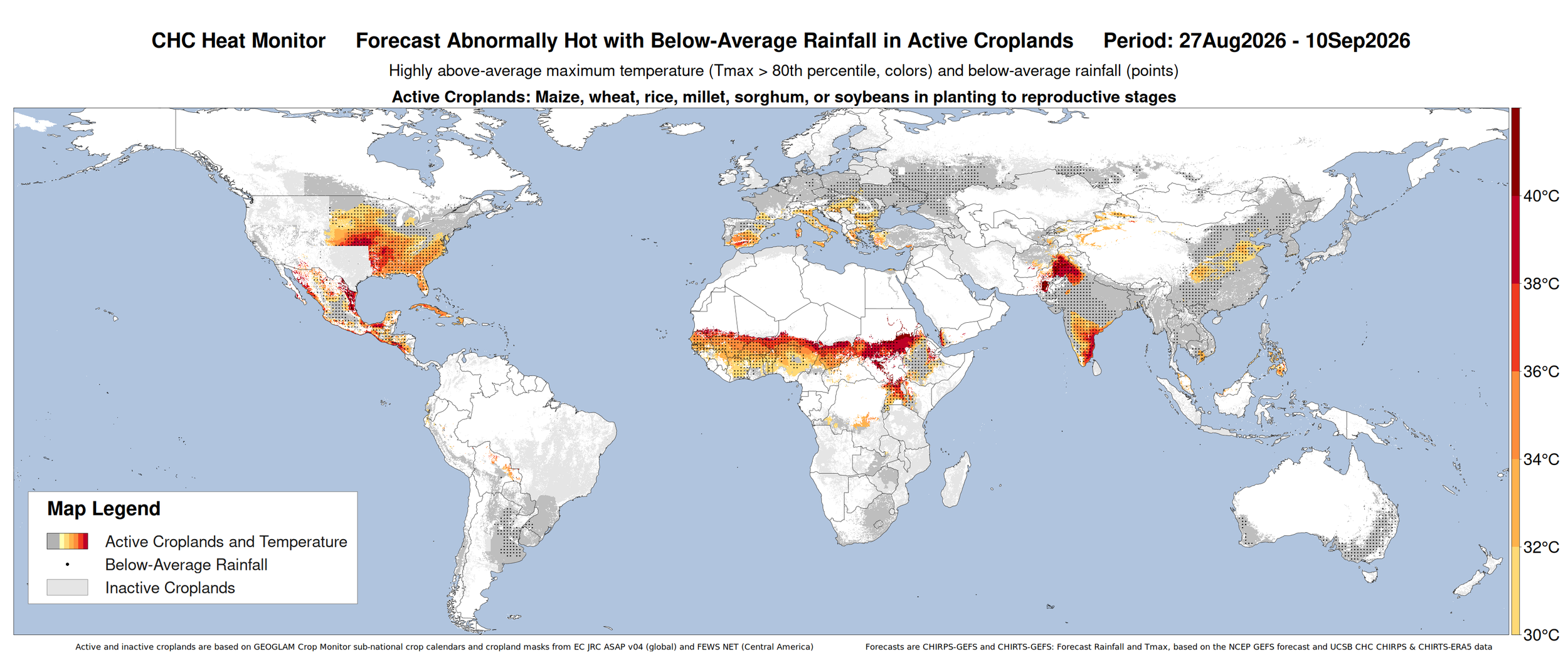
CHC AgriHeat Forecast for August 27 to September 10, 2026. Forecast 15-day average maximum temperatures are shown where they will be abnormally hot (Tmax > 80th percentile and > 30 C) and in active crop-growing areas. Areas with forecasted below-average rainfall for this period are also identified. Based on a 15-day CHIRTS-GEFS forecast from June 26, 2026. From UCSB Climate Hazards Center. Map source: UCSB Climate Hazards Center
Source: UCSB Climate Hazards Center
Regional Outlooks
Both the short-term (2 weeks) and the long-term (3 months) forecasts reflect the warming global temperatures along with the current El Niño and the likely upcoming positive IOD conditions.
In North America, the two-week forecast (Figures 1 & 2) indicates a likelihood of above-average precipitation over the southwest US, while below-average precipitation is likely over western Canada and the mid-Atlantic US. During the same time, temperatures are likely to be above-average over central and eastern Canada and the central and southeastern US. The long-term September-October-November 2026 forecast (Figures 3 & 4) suggests likely above-average precipitation over most of the US, while likely below-average precipitation over the West Coast and northern Prairies in Canada. During the same time, temperatures are likely to be above-average over most of the region, with the highest likelihood over Canada and the northwest US. For additional details, see the CM4AMIS Regional Outlook for the USA.
In Central America & the Caribbean, the two-week forecast (Figures 1 & 2) indicates a likelihood of above-average precipitation over northwest Mexico, while below-average precipitation is likely over southern Mexico, El Salvador, Honduras, western Nicaragua, and the Dominican Republic. During the same period, temperatures are likely to be above-average over Mexico, southern Cuba, Guatemala, El Salvador, southern Honduras, western Nicaragua, and Costa Rica. The long-term September-October-November 2026 forecast (Figures 3 & 4) suggests likely above-average precipitation over northern and central Mexico, while likely below-average precipitation over the rest of the region. During this time, temperatures are highly likely to be above-average over the entire region. For additional details, see the CM4EW regional outlooks for Central America and the Caribbean
Figure 1: IRI SubX Precipitation Biweekly Probability Forecast for 5 – 18 September 2026, issued on 28 August 2026. The forecast is based on statistically calibrated tercile category forecasts from three SubX models. Source: IRI Subseasonal Forecasts Maproom
In South America, the two-week forecast (Figures 1 & 2) indicates likely above-average precipitation over central and southeast Brazil, northeastern Bolivia, and Paraguay, while below-average precipitation is likely over eastern Colombia, northern Ecuador, Venezuela, Guyana, Suriname, French Guiana, northern and southern Brazil, Uruguay, and eastern Argentina. During this time, temperatures are likely to be above-average over western Colombia, Venezuela, Ecuador, northwestern and southern Peru, southwest and northeast Bolivia, northern Chile, Guyana, Suriname, French Guiana, and central and northern Brazil, while below-average over central Peru. The long-term September-October-November 2026 forecast (Figures 3 & 4) suggests likely above-average precipitation over Ecuador, western Peru, south and southeastern Brazil, eastern Paraguay, central and northern Chile, and southern and western Argentina, while below-average precipitation over Colombia, Venezuela, Guyana, Suriname, French Guiana, northern Brazil, eastern Peru, eastern Bolivia, and southern Chile. During that time, temperatures are highly likely to be above-average over most of the region except for Paraguay, Argentina, Uruguay, and southern Brazil, while below-average temperatures are likely in central Argentina.
In Europe, the two-week forecast (Figures 1 & 2) indicates likely above-average precipitation over central United Kingdom, northern Germany, northern Poland, Lithuania, Latvia, Estonia, Belarus, northwestern Ukraine, and the western Russian Federation, while below-average precipitation is likely over Portugal, Spain, southern France, southern Italy, Romania, southern Serbia, Kosovo, Albania, Montenegro, northern Greece, Türkiye, Georgia, Armenia, Azerbaijan, and the southern Russian Federation. During this time, temperatures are likely to be above-average over France, Spain, Portugal, Italy, Austria, Hungary, Romania, Ukraine, Croatia, Bulgaria, Serbia, Kosovo, North Macedonia, Albania, Bosnia and Herzegovina, Greece, Türkiye, Georgia, Armenia, Azerbaijan, and the southern and central Russian Federation, while temperatures are likely to be below-average over the northern United Kingdom, northern Germany, central west Poland, southern Norway, southern Sweden, and southern Finland. The long-term September-October-November 2026 forecast (Figures 3 & 4) indicates a leaning towards above-average precipitation over most of the region. During the same period, temperatures are highly likely to be above-average over most of the region.
Figure 2: IRI SubX Temperature Biweekly Probability Forecast for 8 – 21 August 2026, issued on 31 July 2026. The forecast is based on statistically calibrated tercile category forecasts from three SubX models. Source: IRI Subseasonal Forecasts Maproom
In MENA, the two-week forecast (Figures 1 & 2) indicates a likelihood of below-average precipitation over northwestern Iran, northern Algeria, northeastern Morocco, and southern Yemen. During this time, temperatures are likely to be above-average over most of the region except over eastern Algeria, western Libya, southern Egypt, and eastern Yemen. The long-term September-October-November 2026 forecast (Figures 3 & 4) indicates likely above-average precipitation over Syria, Iraq, Iran, northeastern Saudi Arabia, northern Egypt, western Libya, and northern Tunisia. During this time, temperatures are highly likely to be above-average over the entire region.
In Sub-Saharan Africa, the two-week forecast (Figures 1 & 2) indicates likely above-average precipitation over Côte d'Ivoire, central Angola, southern Zambia, northwestern Zimbabwe, South Africa, and Lesotho, while below-average precipitation is likely over southern Mauritania, Senegal, Mali, Burkina Faso, northern Benin, southern Niger, northern Nigeria, central and southern Chad, central and southern Sudan, South Sudan, Eritrea, central and western Ethiopia, western Kenya, Uganda, Rwanda, Burundi, northern and southern Tanzania, the western Democratic Republic of the Congo, and northern Mozambique. During this time, temperatures are likely to be above-average over most of the region except for the western Democratic Republic of the Congo, South Africa, southern Zimbabwe, southern Mozambique, Lesotho, and Eswatini. For the long-term September-October-November 2026 forecast (Figures 3 & 4), precipitation is likely to be above-average over Mauritania, Mali, northern Côte d'Ivoire, Burkina Faso, Niger, the central Democratic Republic of the Congo, southeastern Ethiopia, Somalia, eastern Kenya, and northeastern Tanzania, while precipitation is likely to be below-average over Liberia, southern Côte d'Ivoire, southern Ghana, Equatorial Guinea, Gabon, the southern Republic of the Congo, northwestern Angola, western Zambia, Zimbabwe, southern and central Mozambique, central Madagascar, South Sudan, southern Sudan, western Ethiopia, and Eritrea. During this time, temperatures are highly likely to be above-average over the entire region. For additional details, see the CM4EW regional outlooks for East Africa West, Africa, and Southern Africa.
Figure 3: Based on August conditions, a probability forecast for the most likely September-October-November (SON) 2026 rainfall tercile. The white colour indicates that there is no dominant category across the model forecasts. Source: WMO Lead Centre for Long-Range Forecast Multi-Model Ensemble
In Central Asia, the two-week forecast (Figures 1 & 2) indicates likely above-average precipitation over northeastern Afghanistan, while below-average precipitation is likely over eastern Kazakhstan. During this time, temperatures are likely to be above-average over most of the region except for eastern Afghanistan, southeastern Tajikistan, and southern Turkmenistan. The long-term September-October-November 2026 forecast (Figures 3 & 4) indicates likely above-average precipitation over the entire region. At the same time, temperatures are likely to be above-average over most of the region.
In South Asia, the two-week forecast (Figures 1 & 2) indicates likely below-average precipitation over southern and northern India and Sri Lanka. During this time, temperatures are likely to be above-average over northern Pakistan, northern and southern India, Nepal, Bhutan, and southwestern Sri Lanka, while temperatures are likely to be below-average over central India. The long-term September-October-November 2026 forecast (Figures 3 & 4) indicates likely above-average precipitation over northern Pakistan and Sri Lanka, while likely below-average precipitation over India, Nepal, Bhutan, and Bangladesh. During this time, temperatures are likely to be above-average over the entire region.
In East Asia, the two-week forecast (Figures 1 & 2) indicates likely above-average precipitation over southwestern China and the Republic of Korea, while below-average precipitation is likely over northwestern and eastern China. During this time, temperatures are likely to be above-average over most of the region except for eastern Mongolia, northeastern China, the DPRK, and central Japan. The long-term September-October-November 2026 forecast (Figures 3 & 4) indicates likely above-average precipitation over northern northwestern and eastern China and northern Japan, while likely below-average precipitation over southwest China. During that time, temperatures are highly likely to be above-average over most of the region except for southwest and northeast China.
In Southeast Asia & Oceania, the two-week forecast (Figures 1 & 2) indicates likely above-average precipitation over eastern Myanmar, northern and northeastern Thailand, and northwestern Laos, while below-average precipitation is likely over southern Thailand, the southern Philippines, Malaysia, Brunei, Indonesia, Papua New Guinea, eastern Australia, and northern New Zealand. During this time, temperatures are likely to be above-average over eastern Myanmar, Lao PDR, Thailand, Viet Nam, northern Cambodia, the central and southern Philippines, Malaysia, Indonesia, western Papua New Guinea, most of Australia, and New Zealand, while below-average temperatures are likely over southern Cambodia. The long-term September-October-November 2026 forecast (Figures 3 & 4) indicates likely above-average precipitation over western Australia and southern New Zealand, while likely below-average precipitation over western Myanmar, central Thailand, southern Laos, Viet Nam, the Philippines, Malaysia, Indonesia, Papua New Guinea, southwestern and southeastern Australia, and northern New Zealand. During the same time, temperatures are likely to be above-average over most of the region except for southeastern Indonesia, southern Papua New Guinea, and northern Australia. For additional details, see the CM4AMIS regional outlook for Australia.
Figure 4: Based on August conditions, a probability forecast for the most likely September-October-November (SON) 2026 temperature tercile. The white colour indicates that there is no dominant category across the model forecasts. Source: WMO Lead Centre for Long-Range Forecast Multi-Model Ensemble